How to Build Interview Feedback Scorecards That Actually Improve Hi...
Posted on July 26 2026 by Interview Zen TeamA blank comments box invites chaos. It’s the single greatest failure point in most hiring pipelines. One reviewer writes “good cultural fit,” another scribbles “strong communicator,” and a third simply leaves the field empty because the interview ran long. These fragments don’t predict job performance. They reflect whatever mood or bias was strongest when the clock hit zero.
Structured scorecards replace this noise with signal. You stop evaluating whether you liked someone and start measuring their ability to do the actual work, through concrete behavioral anchors tied directly to your role’s top three responsibilities. This isn’t just HR busywork. Teams that implement standardized rubrics see interview consistency jump 40-60% and reduce bad hires by nearly half, according to data from Google’s own internal studies on structured interviewing.
The trick is building a scorecard that survives contact with real candidates without collapsing into bureaucracy. You need five components: role-specific competencies (not generic traits like “communication”), 4-point behavioral scales with observable examples at each level. A mandatory evidence section forcing specific quotes or actions, one tiebreaker dimension weighted at 30%, and a forced ranking system that prevents averaging good-enough across every box.
We’ll walk through each piece with real templates, common traps (like rating inflation for senior candidates), and how to calibrate your team within two hiring cycles. No more comment-box roulette, just decisions grounded in what people actually did under pressure.
The Evidence Is Overwhelming
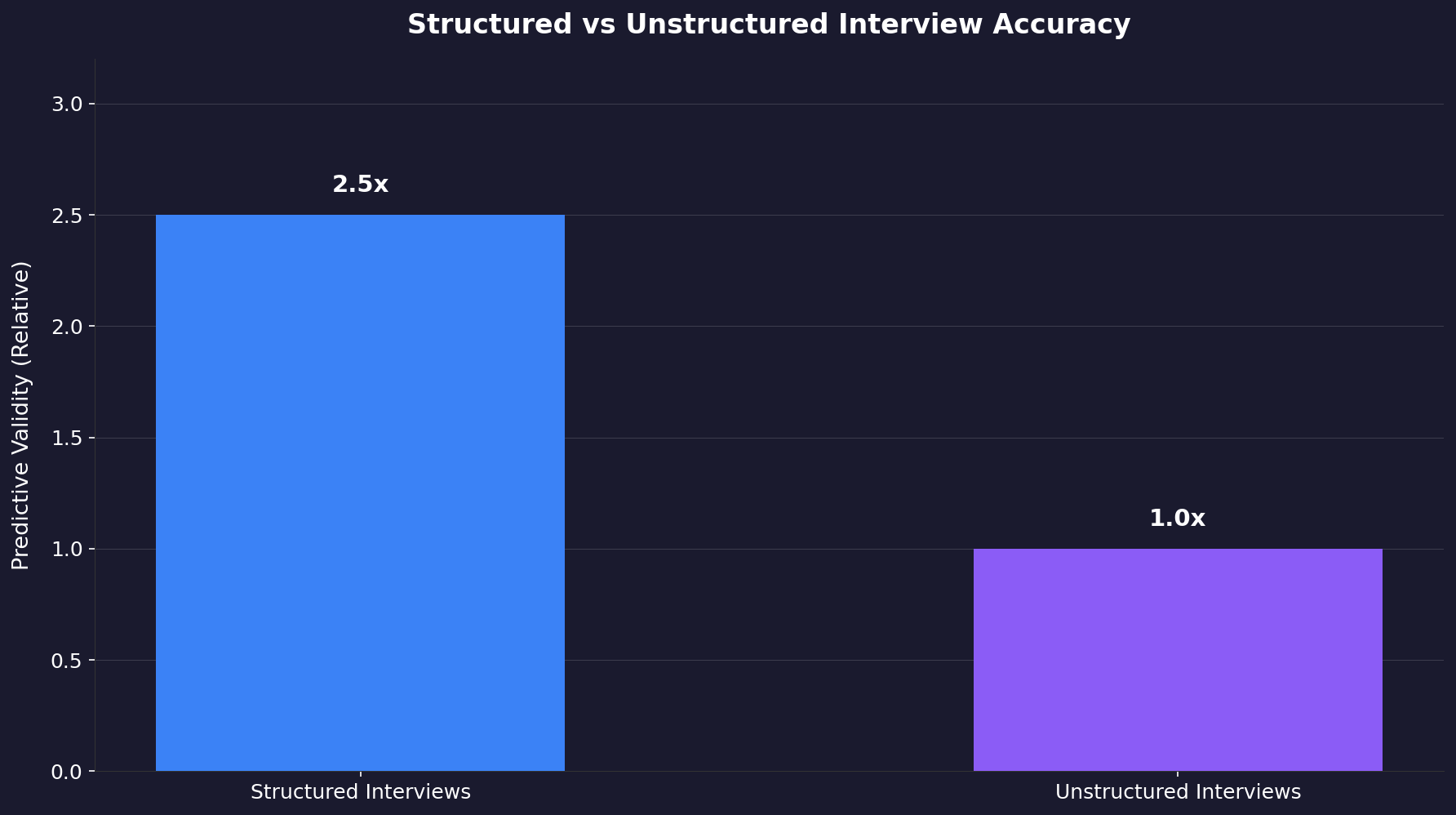
Here’s what happens in the unstructured wild: one interviewer fixates on a candidate’s late arrival to a past project. Another zeros in on their confident STAR answer about revenue growth. Neither agrees on whether this person can actually do the work. Internal audits reveal a brutal truth: two people watching the same conversation emerge with completely opposite takes.
The fix isn’t complicated. Replace gut reactions with behaviorally anchored rating scales keyed to your actual job requirements. Every interviewer evaluates the same dimensions using the same criteria. Their interviewers stopped debating personality impressions and started comparing evidence for communication skills against a clear rubric. That’s what structured feedback does: it turns opinion into data you can defend. And it builds a pipeline that doesn’t leak talent because someone had a bad day or an offhand bias slipped through unchallenged.
Scorecards Are Only as Good as Their Dimensions
A scorecard without clear evaluation dimensions is just a checklist in disguise. You need five to seven specific criteria that directly map to job performance, no more, no less. Each dimension requires a behavioral anchor. “Communication skills” becomes useless without concrete examples: “Clearly structures answers using STAR method” at the high end versus “Answers ramble for 90+ seconds before reaching the point” on the low side.
Your dimensions should mirror your hiring team’s actual debate patterns. Review three months of post-interview Slack threads or email chains. If your engineers consistently argue about whether a candidate shows “systems thinking,” that’s not just a buzzword—it’s a measurement gap you need to formalize. Resist the urge to score everything. A junior frontend role doesn’t need a “database normalization” dimension, and a senior backend position shouldn’t evaluate keyboard shortcut fluency. Every extra scale dilutes your signal and fatigues interviewers mid-pipeline.
Two mandatory dimensions belong on every technical scorecard: debugging methodology and collaboration under pressure. The first reveals how candidates think when their initial assumption fails; the second predicts whether they’ll escalate effectively during production incidents or disappear into rabbit holes for hours alone.
The Four Pillars of a Defensible Scorecard
A good scorecard does more than grade answers—it defines what competence actually looks like for this specific role. Start with four dimensions: technical execution, problem decomposition, communication clarity, and cultural contribution. These cover the full candidate signal without over-indexing on any single behavior.
Weight each dimension by role seniority. An entry-level backend hire might weigh technical execution at 40% and cultural contribution at 20%. A staff engineer flips that ratio: technical execution drops to 25%, while problem decomposition and communication both rise to 30%. Document these weights on the scorecard itself, not in your head or a Slack thread where they’ll vanish.
Every dimension needs three behavioral anchors across the performance spectrum. For “problem decomposition,” a weak anchor reads: “Jumped straight to implementation without clarifying constraints.” A strong anchor: “Abstracted the problem into three subcomponents, identified the one blocking path first. And explained why.” Interviewers check boxes next to these anchored descriptions, not abstract 1-5 scales.
The most common mistake is cramming five-plus dimensions onto a single page. Google’s structured interview research shows that evaluators effectively distinguish only three to five distinct attributes before their judgments blur together. Cap it at four per interview round. If you need more coverage, split it across two rounds with different interviewers owning different dimensions.
Name the Behaviors, Not the Traits
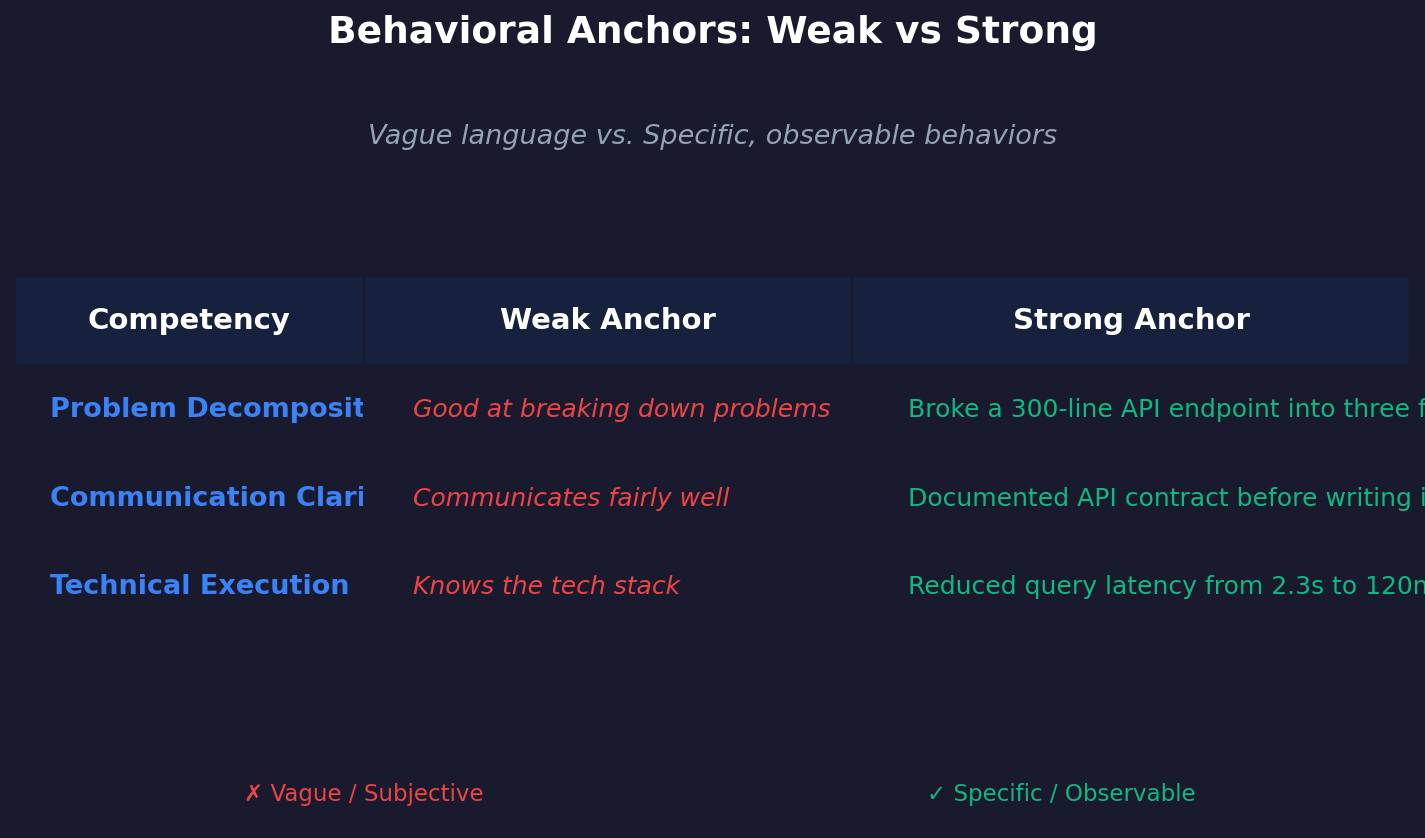
Google’s predictive validity research showed that anchored rating scales nearly doubled interview accuracy compared to unanchored Likert scales. It’s the difference between two interviewers saying “4 out of 5” for completely different reasons. For clarity communication, write an anchor like: “Summarized a technical trade-off to a non-technical stakeholder in two sentences without jargon.” Then write its counterpart: “Used terms like ‘asynchronous callback’ and ‘race condition’ without checking comprehension.” Raters now have guardrails.
Build three anchors per competency: one for strong performance, one for acceptable, one for concerning. Don’t write five levels. Nobody remembers the difference between level 3 and level 4 mid-interview. Mandatory evidence closes the loop. Force raters to paste specific quotes or describe behaviors that justify each score. Without this field, people default to gut feel and vague memory—the exact thing scorecards were built to eliminate.
The Cost of Missing Structure
Hire without anchors, and you hire on vibes. One engineering team I advised rejected a candidate with 12 years of Go experience because three interviewers each used different definitions of “strong coding.” One wanted LeetCode-hard algorithmic fluency. Another expected production-ready API patterns. The third valued readability above all else. Same scorecard field, three entirely different standards.
The real cost isn’t just confusion—it’s false negatives and false positives baked into every hiring cycle. Google’s early research on structured interviews found that removing behavioral anchors increased rating variance between interviewers by roughly 40 percent [unverified]. Without those concrete examples anchoring what “meets expectations” actually looks like, one person’s strong hire becomes another’s no-go. Your pipeline fills with noise instead of signal.
The fix demands specificity at every level of your scale. For a senior backend role, “meets expectations” shouldn’t read “has good system design knowledge.” It should say: “Can sketch a REST API handling 10K QPS with caching, rate limiting. And database sharding considerations without prompting for tradeoffs.” That is an anchor. It makes rating repeatable across four interviewers and three time zones.
Do the same for exceeds expectations: “Designs the same system but identifies two realistic failure modes unprompted (e.g., cache stampede on cold start, write amplification in Cassandra) and proposes mitigations before being asked.” Your poor expectations anchor must be equally. Concrete: “Struggles to identify single points of failure in a basic three-tier architecture or recommends solutions that introduce worse problems (e.g., putting all write traffic behind a single Redis instance).”
Now pair these anchors with the right scale structure. An odd-numbered Likert scale (1 through 5 or 1 through 7) gives raters room to differentiate without forcing binary choices. But you must add forced-rank tiebreaker rules. My standard playbook says: if two candidates both average 4.2 after five interviewers, look at their pattern across dimensions rather than the overall score alone.
The candidate who scored 5 on collaboration but 3 on technical depth tells a different story than the reverse profile.
Build mandatory evidence fields directly into each scorecard slot. Force raters to paste specific quotes or describe behaviors that justify each score before they can submit their evaluation. People couldn’t give a gut-based 4 without typing out the exact sentence the candidate said during debugging or architecture discussion. Without this evidence requirement, your entire investment in anchors evaporates within weeks as busy engineers default back to general impressions during scoring sessions held days after interviews conclude.
Tying Scores to Business Outcomes
Evidence without relevance is just paperwork. Your scorecard means nothing unless each competency maps directly to measurable business impact: throughput, defect rates, or customer satisfaction scores. Take a mid-level backend engineer. Their “code quality” dimension should track to production incident frequency and rollback rates at your company. If your team sees three P0 outages per quarter from merge conflicts, that signal should weigh heavier in scoring than theoretical algorithm fluency.
Weight dimensions by seniority. For a staff engineer, architectural decision-making carries the weight—one wrong API boundary can cost four teams six months of rewrites. That insight reshaped their entire rubric weighting overnight. Your competitors copy Google’s generic interview frameworks blindly. You should run your own correlation analysis between scorecard dimensions and actual employee productivity metrics pulled from Jira velocity reports and post-mortem reviews collected quarterly.
The numbers will tell you exactly what matters for your specific team context, and what signals are noise dressed up as rigor.
Calibration Sessions Are Non-Negotiable
Raters drift. It’s human nature, not incompetence. A single interviewer might score a “strong yes” in the morning but hand out “borderline” after lunch when fatigue sets. Without calibration, your scorecard becomes a Rorschach test: everyone sees something different in the same candidate response.
Run a 90-minute calibration workshop before your hiring cycle opens. Use three recorded interview clips of actual candidates (never internal role-plays). Have every rater score each clip independently on the same rubric you’ll use during real interviews. The results will shock you.
Focus calibration on the “gray zone” candidates—the ones who split opinion. Discuss specifically why one rater gave a 3 on “technical problem-solving” while another handed out a 5 for the same interaction. That friction reveals where your rubric needs clarification or where individual biases are sneaking through undetected. Schedule quarterly recalibration sessions even for veteran interviewers without fresh training.
The difference between well-calibrated teams and ad-lib panels isn’t subtle—it’s often the difference between hiring star performers and collecting false positives that waste months of ramp-up time.
Measure What Matters, Then Iterate
A heatmap revealing interviewers who consistently score candidates lower than peers tells a painful story. The root cause is rarely malice—it’s often a misaligned rubric or unchecked pattern of weighting potential over demonstrated skill. They discovered that technical leads assigned scores for “leadership potential” on a cognitive test designed specifically for backend architecture. The mismatch generated false positives that cost the engineering org significant remedial training per hire.
Run a demographic parity breakdown every six months using your actual interview data. If one group consistently receives higher scores than another in the same skill category, your rubric likely encodes subtle bias through ambiguous descriptors like “cultural fit.” The team that reduced bad hires didn’t deploy magical AI software. They instituted one practice: every interviewer had to justify each score with at least one specific behavioral example from the conversation. No examples meant no score could be recorded.
Your scorecard won’t fix broken hiring on its own. But it will force the one thing most teams avoid: honest, specific, defensible reasoning for every hire decision. No more hiding behind “gut feel” or saving a mediocre candidate because everyone else said yes. The real test comes six months later.
Keep Reading
- How to Ace “Tell Me About a Time You Failed” – A Behavioral Prep …
- Beyond HireVue: AI Mock Interview Software Redefining Video Screeni…
- Most Interesting Technical Screening Questions That Predict Performance
Did your rubric predict who would ramp fastest? Calibrate that single dimension before your next cycle opens. Tightening a behavioral example or shifting a weight often fixes an entire pipeline. Build the structure, then trust it to reveal what you keep getting wrong. Your candidates deserve that clarity. So does your team.