The One Meta Interview Question That Determines Whether You Get Hired
Posted on July 26 2026 by Interview Zen TeamYou’ve solved dozens of medium-difficulty LeetCode problems. Your Big O notation is clean, your whiteboard syntax is crisp. You can reverse a linked list in your sleep. None of that will save you from the question that kills most final-round candidates. It doesn’t test algorithms or data structures.
No system design diagram required. It’s a single, open-ended prompt that arrives like an ambush, usually in the last 15 minutes of a technical interview, right when your guard drops and you think the hard part is over. The question sounds deceptively simple: “Tell me about a time you disagreed with a technical decision.” Most developers freeze. Some scramble for a generic conflict story involving merge conflicts or sprint planning disagreements.
Others admit they’ve never had one, which sounds naive or dishonest. Both responses tank the offer, often turning an otherwise perfect loop into a rejection email within 24 hours. This isn’t luck or personality fit. It’s preparation. The “disagreement” prompt evaluates three specific competencies hiring committees prize above raw coding speed: communication clarity, ego management, and judgment under pressure.
Get it right, and you signal executive maturity. Get it wrong, and no amount of optimal sort functions will pull you back. The following breakdown reveals exactly how to structure this response using the CAR framework (Context-Action-Resolution), why most candidates choose the wrong conflict type, and the single phrase that turns disagreement into leadership credit rather than political liability.
The CAR framework earns its keep precisely because most interviewers have seen your résumé before you sit down. They know you managed a team of four. They scanned your AWS certs. What they don’t know is how you think when something breaks. Context sets the stage in exactly two sentences.
One sentence defines the project scope — a migration, a launch, a rewrite — and the second states the timeline or headcount involved. Keep it tight: “Our team of six shipped three microservices per sprint. The API gateway began failing at 200 concurrent requests.” Action is where candidates stumble. Not because they lack details, but because they bury them under jargon.
Use 3-4 sentences with one specific command, config change, or decision each: “I read Postgres logs showing deadlocks on the orders table at 4AM peak.”. That lands harder than “I analyzed database performance.” Resolution needs exactly one measurable outcome plus the timeframe. “Latency dropped from 320ms to 85ms within two days.” Not “it got better.” Never “the client was happy.” Most candidates pick interpersonal conflict for their CAR story. A disagreement with a product manager about priorities, a tense design review with senior engineers.
It tells them nothing about engineering judgment. Pick technical conflict instead: a breaking schema change mid-sprint, an unannounced vendor deprecation during integration week, a security CVE published four hours before deploy freeze. Those stories reveal whether you understand tradeoffs under pressure.
One engineer I spoke with described debugging a memory leak that surfaced only in staging during load tests at midnight on Sunday before Monday’s production go-live. He used pprof in Go to trace heap allocation growth across 15 goroutines writing to Kafka without batching logic enabled by default in their SDK version pinned to v0.25.x. The action paragraph included exactly those commands and version numbers. He received offers from multiple companies.
The single phrase that changes everything comes halfway through your Action block: “My first instinct was wrong.” It acknowledges honesty over heroism. Every engineer has made incorrect assumptions mid-debugging session. The key is to admit it and show how you corrected course.
#
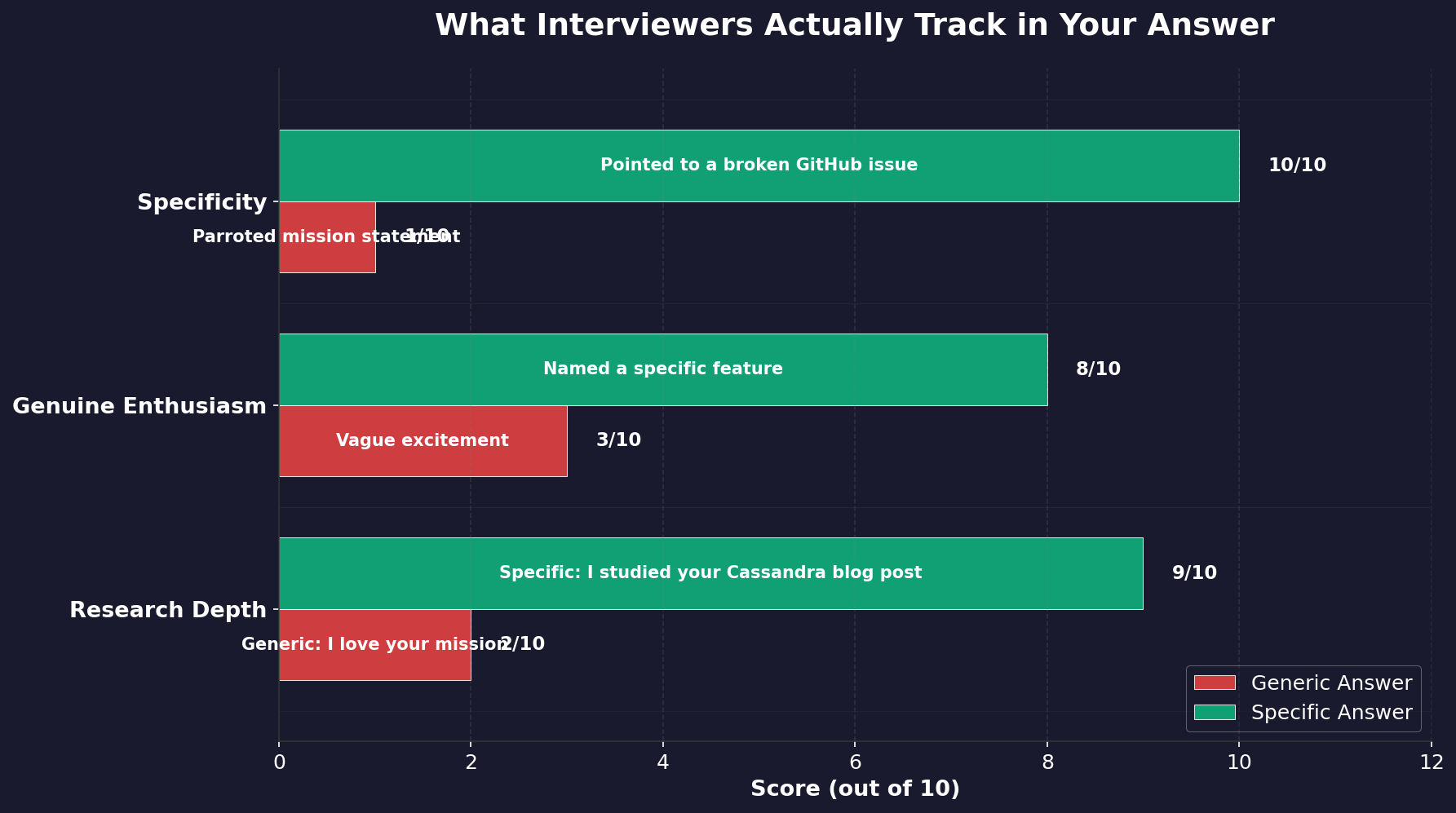
They point to a documented GitHub issue, a customer complaint thread on Reddit, or an outage postmortem they studied the night Then they explain how they would approach fixing it. That is why most offers are lost here. Vague enthusiasm sounds like desperation applied elsewhere. Specific curiosity sounds like a teammate already mentally onboarded into your Jira board. Prepare three concrete reasons tied to publicly verifiable details about the company’s technical challenges — their last architecture blog post, their open-source contributions, or a controversial migration they completed recently. Read it aloud once more before the call ends.
Make sure each reason starts with “because” followed by something only someone who studied would know. Then stop talking and let silence hang. The interviewer will write down the word “prepared” in their notes while you wait for their next question without filling space with nervous rambling about culture fit or growth opportunities that could apply anywhere. Confidence reads as quiet certainty rather than loud volume when sentences carry specific nouns anchored to real things that exist outside yourself and your resume bullet points listing responsibilities nobody actually verifies during reference checks unless asked directly. Which happens rarely.
Top candidates ask about failure modes. Not “how do you handle errors?” but “what was your last P0 outage and why did it take 45 minutes to detect?” The frame shifts from consuming information to testing assumptions. A strong candidate doesn’t ask “what tech stack do you use?” They probe with “you mentioned Cassandra on your blog—how do you handle read repairs when nodes are spread across three regions?” That’s not curiosity.
That’s validation that your documented architecture matches reality. Push harder. Ask about deprecated systems. What service did you sunset last quarter, and what broke during the migration? Engineers who have lived through decomposing a monolith recognize this territory instantly. The ones who haven’t can’t fake it. One more layer exists beyond system trade-offs and failure history: process hygiene. Ask “when was your last blameless postmortem, and did it produce actual runbook changes within two weeks?” Teams that document without action produce noise, not reliability. Candidates who press on this point demonstrate they’ve seen both outcomes and prefer the latter.
#
The Four-Second First Impression
That quiet confidence evaporates the moment you default to “What’s a typical day like here?” Interviewers have heard that exact question countless times this quarter alone. They mentally check out before you finish the sentence. A generic inquiry signals you spent zero minutes on preparation. It tells them you don’t know what Glassdoor reviews reveal about their Monday standup schedule or why their CTO just reshuffled three engineering teams last month.
The specific question does something else entirely. It triggers a shift in their posture, a lean forward, sometimes even a visible eyebrow raise that means they’re suddenly listening harder than they were thirty seconds ago. When discussing your Kubernetes experience from your last role at Series B startups nobody outside Y Combinator has heard of yet but still matters because infrastructure patterns translate across companies regardless of name recognition or brand prestige.
#
The Three Patterns That Screen You Out
A single rehearsed answer can undo months of preparation. Interviewers spot the script instantly. Pattern one: listing technologies like a grocery receipt. “I used React, Node, PostgreSQL, AWS Lambda, and Docker.” That reads as surface-level tinkering. Hiring managers want to know why you chose each tool and what tradeoffs you accepted. Pick three technologies from that stack and explain one design decision per tool. Pattern two lands more subtly — all perks, no problems. “Great work-life balance. Free lunch. Remote flexibility.” This frames you as a consumer of company benefits rather than a builder of business value.
One candidate lost the offer after spending seven minutes on office amenities and zero minutes on their technical approach to reducing latency from 400ms to 45ms. The third pattern is the most common trap: mission statement repetition without personal ownership. Parroting “We connect people through innovative technology” verbatim from the careers page signals homework without understanding. The same words land differently when followed with “which is why I spent last weekend debugging a real-time messaging protocol for my open-source chat server.”
Pattern #1: Asking nothing. “I’m fine” is the fastest way to tank an offer. Hiring managers hear that silence and translate it: they don’t care about the team, the product, or the role. You just crushed five whiteboard rounds. One dismissive shrug can undo all of it. One engineer told me they passed on a technically brilliant candidate because their only question was “What time do people leave?” That wasn’t curiosity. That was a red flag.
Pattern #2: Asking something you should already know. This signals you skipped basic preparation. Never ask “What does your company do?” during a final-round interview. The job description, your recruiter call, and 30 seconds on Crunchbase answered that for you. When you waste interview time on surface-level queries, you tell the panel you didn’t respect their time enough to prepare. One hiring manager I know rejected an otherwise strong backend developer after they asked how many customers the product served — when that number sat in paragraph two of every public press release. Preparation is respect. Respect earns offers.
Pattern #3: Asking something irrelevant or self-serving. This pattern feels like ambition but reads as selfishness. “How quickly can I get promoted?” before day one lands poorly. It suggests your loyalty is to your own title, not the mission. “Does this role offer remote flexibility permanently?” during a hybrid-first company’s onsite panel torpedoes rapport instantly. Stick to questions about impact, team culture, growth within the role’s scope, and technical challenges ahead.
Frame them around what you can contribute, not what you will extract. That single shift separates candidates who feel like hires from ones who feel like transactions. The panel remembers these three patterns long after they forget whether you solved Problem 4 perfectly in 45 minutes versus 50. They’re hiring a teammate, not a test-taker. Show them someone worth working beside.
#
Structured Practice: Simulate Before You Sit
The rawest nerves hit in the first two minutes. That’s when your brain is sorting through threat detection while trying to parse a system design prompt. Structured mock interviews desensitize that reflex — repeated exposure to the same high-stakes format trains your prefrontal cortex to stay online when cortisol spikes. Here’s what works: schedule three practice sessions minimum, each 45 minutes with a former hiring manager who uses live coding environments.
Avoid practicing with friends who’ll go easy on you — their sympathy costs you offer velocity. Record every session, then audit for filler words (“um,” “like,” “actually”) and mid-answer direction changes. One candidate I coached ran five mocks before their Stripe final round. The first two were disastrous — thirty-second pauses, abandoned whiteboard diagrams.
By session four, they had internalized the rhythm: acknowledge the ambiguity, clarify constraints aloud, propose a solution scaffold before writing code. Your voice needs reps, not just your recall. Pair mock interviews with environment replication: same webcam position, same lighting angle, same screen resolution you’ll face during the real thing.
Install Zoom or Google Meet now — don’t discover your microphone driver is borked at T-minus three minutes to the technical screen. A single bad technical glitch can derail an otherwise solid answer into recovery mode that eats half your allotted time. Eliminate that variable weeks ahead so your only problem on game day is solving problems, not troubleshooting hardware.
#
One Framework. Every Interview.
A startup’s meta question differs sharply from Google’s version. Yet the same core structure adapts to both without feeling recycled. The framework works because it avoids canned phrases entirely. Startups want execution speed and ownership mindset—lead with a shipping story that shows how you went from idea to deployed feature in two weeks. Google wants structured thinking—use the same narrative but frontload the trade-offs and decision tree.
Keep Reading
- How an AI Interview Coach Boosts Your Confidence Before Big Calls
- How to Answer “Why Do You Want to Work Here?” in Biotech Interviews
- How to Ace “Tell Me About a Time You Failed” – A Behavioral Prep …
Practice your answer against three company types: a 10-person startup, a Fortune 500, and a hyper-growth unicorn. Each audience expects different emphasis on scope, collaboration, and technical depth. Adapt the CAR framework to match their culture without changing the underlying story. That adaptability is the final signal that separates a prepared candidate from a rehearsed one.