Beyond Basic Video Interviews – Why Hiring Managers Are Switching...
Posted on July 26 2026 by Interview Zen TeamBest Spark Hire alternatives for hiring managers
Most “interviewing” platforms are glorified calendar apps. They’ll schedule your candidate for Tuesday at 2 PM and email you a Zoom link, but they can’t tell you whether she freezes up the moment you ask her to reverse a linked list on a whiteboard. That’s where the real disconnect happens.
It’s costing engineering teams weeks of wasted cycles on candidates who look great on paper but crumble under pressure. The hiring market has shifted dramatically over the past three years, yet most video interview tools still treat technical evaluation as an afterthought. You’re left stitching together Zoom recordings, Codepen links, and spreadsheet-based rubrics in a Frankenstein workflow that leaks candidate experience and bias at every seam.
This guide covers six Spark Hire alternatives built specifically for hiring managers who need to evaluate real coding ability, not just communication polish. We’ll break down which platforms handle live collaborative editing, async take-home challenges that match your tech stack, and automated plagiarism detection so you know whose code is actually theirs.
Key criteria: We tested each tool on four dimensions: technical assessment fidelity, bias-reduction features (like anonymous grading), integration depth with ATS systems like Greenhouse or Lever, and per-hire cost for teams running fewer than 50 interviews monthly. Whether you’re scaling a Series B team or replacing a legacy pipeline that produces too many false positives, these alternatives close the gap between “they talked well” and “they can ship.”
The coding interview’s blind spot
A candidate aces the whiteboard. Solved in 22 minutes. The team is impressed. Then they fail the take-home. It takes three days. The code compiles but ignores edge cases, error handling, and basic security patterns. This gap kills trust between engineering leaders and their assessment tools.
General platforms like HireVue or Codility score algorithm speed well but miss the production-readiness that defines senior talent. The dropout rate spikes when question complexity mismatches role expectations. System design knowledge doesn’t predict commit hygiene. A developer with seven years of backend work doesn’t need another palindrome check; they need to articulate how they handled a production incident, pushed back on product deadlines, or refactored legacy infrastructure without breaking test coverage.
These are the signals general platforms cannot capture—and why niche alternatives now dominate hiring roadmaps for teams serious about reducing false positives in their funnel.
Key criteria: A replacement must isolate algorithmic thinking from deployment judgment using separate scoring rubrics, support asynchronous screeners. That mimic real PR review workflows (GitHub integration + CI pipeline hooks), and offer adaptive difficulty scaling so junior candidates aren’t crushed by concurrency problems meant for staff engineers.
What makes a good technical screener
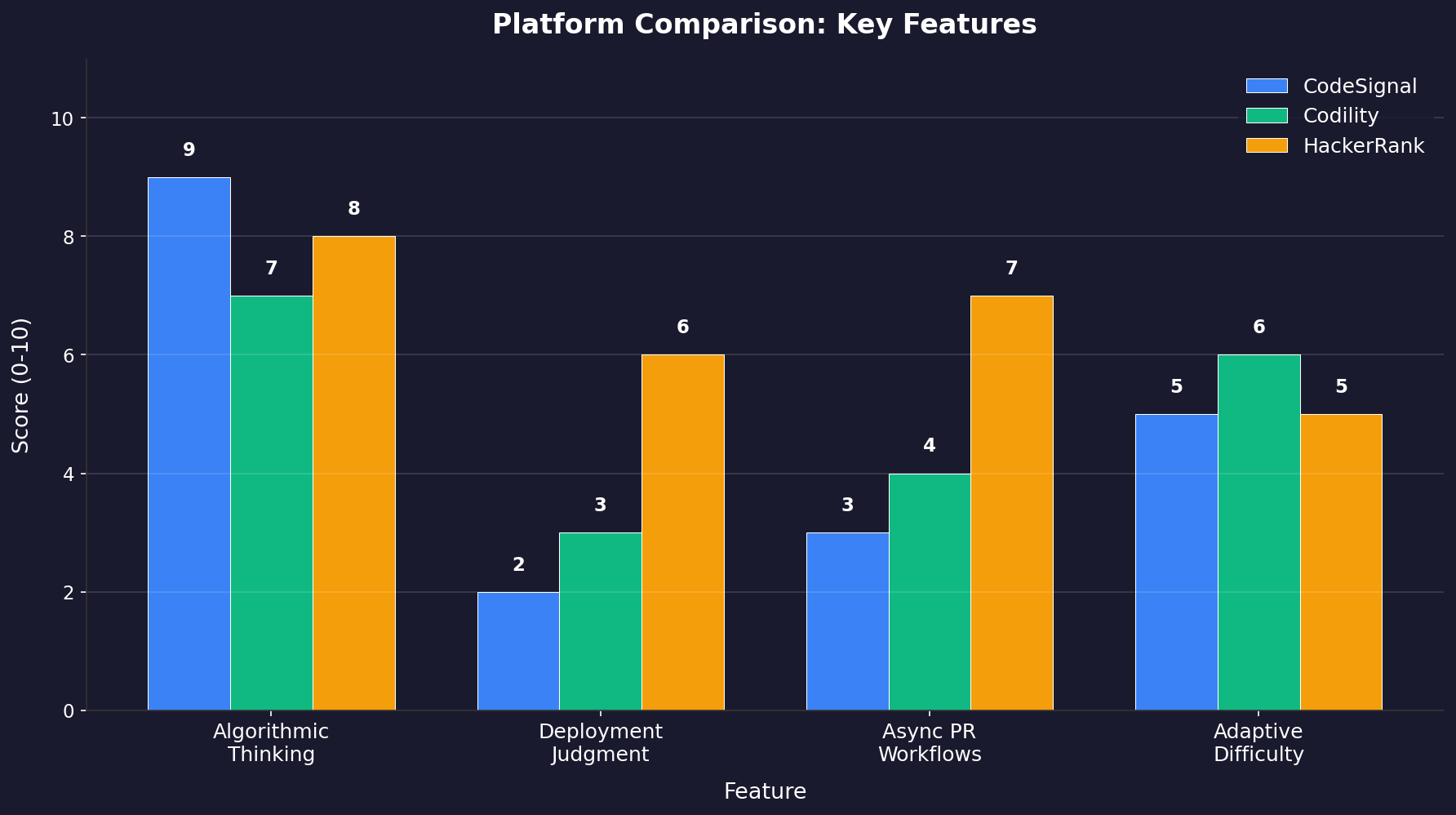
Adaptive difficulty scaling matters more than most teams realize. Junior engineers crushed by concurrency problems designed for staff-level roles will simply ghost your funnel. Conversely, senior candidates resent spending two hours on FizzBuzz variations before reaching anything substantive. The best platforms now offer tiered question banks with verified difficulty ratings. At least five distinct levels is the baseline—anything fewer and you’ll inevitably mismatch candidate experience with problem complexity.
CodeSignal’s GCA framework grades general coding ability, but it deliberately avoids deployment context or system design judgment. For teams hiring platform engineers at Canva or Stripe, that abstraction gap creates false positives: strong algorithm test-takers who cannot reason about sharding or latency budgets.
Codility serves quick screening well—its library of verified problems spans 50+ programming languages with runtime analysis built But the single-score output obscures the fundamental distinction between “can solve” and “can ship.” A perfect Codility score does not predict whether someone will write maintainable infrastructure code under production constraints.
HackerRank offers role-specific assessments targeting backend engineering, full-stack development, or DevOps domains separately. Their scoring rubric weights multiple competency axes independently—a candidate might ace algorithms but score poorly on debugging scenarios, flagging precisely where follow-up interviewing needs focus. For teams hiring at scale, HackerRank for Work provides automated plagiarism detection through keystroke pattern analysis and copy-paste monitoring during timed assessments.
False positives remain a concern (skilled candidates may simply type quickly), but the detection systems have improved substantially over raw time-on-task heuristics alone.
The real differentiator lies in how these platforms handle tradeoff conversations during live assessment sessions. Candidates should be asked why they chose synchronous replication over asynchronous eventual consistency for a specific workload profile—not merely to build a Redis clone from scratch in two hours without libraries permitted. The change didn’t just filter better—it also attracted stronger applicants who self-selected out of LeetCode-heavy processes entirely.
Bias reduction through structured interviews
A well-designed question bank is the single most effective tool for reducing interview bias. Spontaneous question writing tends to favor candidates whose backgrounds mirror the interviewer’s own experience. A frontend engineer at Google who writes a custom React state management problem will unconsciously embed assumptions that only developers with similar Stack Overflow browsing history can decode quickly.
A curated bank solves this by enforcing role-specific parameters: every frontend candidate answers a problem drawn from the same pool of 50 verified React, TypeScript, and CSS architecture questions. Language support matters more than most teams realize. The percentile ranking feature changes how hiring managers interpret results. The ranking contextualizes raw scores against thousands of prior attempts, converting subjective feelings into objective probability curves.
A structured interview protocol does more than standardize evaluations—it actively dismantles unconscious bias. The gap is entirely human fallibility. Bias seeps in through small channels. A soft handshake subtracts credibility points no one writes down. Structured rubrics force evaluators to measure what matters: technical competence, communication clarity, problem decomposition.
Your rubric should weight each dimension explicitly before seeing any candidate. Five points for algorithmic thinking, three for code organization, two for testing strategy—published upfront and immutable during interviews. No scoring after the fact, no adjusting weights because someone had a “good feeling.” The most overlooked source of bias is question selection drift. Interviewers naturally gravitate toward problems they find personally interesting or that match their own specialization areas over time.
Use a rotation system with pre-approved question pools refreshed every quarter.
The real insight is counterintuitive: more structured doesn’t mean less personal. A rigid bank gives interviewers permission to spend cognitive energy on actual conversation rather than puzzle-solving anxiety. When both parties know the question was fair and uniformly applied, the feedback loop tightens dramatically—candidates trust the process enough to show their genuine thought process instead of performing for perceived preferences.
The platforms you choose won’t fix a broken hiring process. They just amplify whatever foundation you already have. That’s the uncomfortable truth most tool comparisons gloss over. A polished video interface cannot salvage a rubric that rewards charisma over competence, nor can automated scheduling repair trust broken by ghosting candidates for weeks.
Your assessment framework matters more than any feature list. Start by defining exactly what “good” looks like for each role: the specific debugging workflow, the architectural tradeoff conversation, the commit history patterns. Then find a platform that lets you evaluate those signals directly. Ask yourself one hard question before signing any contract: Does this tool make it easier to discover hidden talent, or just easier to eliminate everyone who doesn’t fit your unconscious mold?
Keep Reading
- How to Ace “Tell Me About a Time You Failed” – A Behavioral Prep …
- Beyond HireVue: AI Mock Interview Software Redefining Video Screeni…
- Most Interesting Technical Screening Questions That Predict Performance
The right answer reshapes your entire pipeline. The wrong one just adds another monthly subscription to your recruiting stack.