How to Ace "Tell Me About a Time You Failed" – A Behavioral Prep ...
Posted on August 13 2026 by Interview Zen TeamWhy This Question Feels Harder Than Any Technical Problem
Shame hijacks the prefrontal cortex. That’s the part of your brain responsible for recall, sequencing, and coherent speech—everything you need to nail a behavioral interview question. When an interviewer asks about failure, your amygdala lights up before your frontal lobe processes the words. Research from Brené Brown’s Shame Resilience Theory shows that naming a shame trigger reduces its emotional grip by engaging rational thought centers.
Your body interprets “tell me about failure” as social threat. The same circuits that react to physical danger—elevated cortisol, narrowed attention span—activate when you expose professional weakness in front of a hiring manager. This is evolutionary wiring working against modern interview dynamics. Hiring teams don’t care about your failure per se. They care about what happened afterward: Did you diagnose the root cause? Did you change your behavior? Did you prevent it from recurring?
The trap is storytelling paralysis. Most people default to one of two dead ends: they either confess a catastrophe too raw (fired for missing quota) or fabricate something trivial (missed a typo in an email). The third path is harder but works every time. Pick a real failure from the last two years, ideally something that cost measurable time or money.
I’ve coached dozens of engineers through this exact moment, and the ones who succeed share a pattern: they treat the failure as a case study, not a confession. One backend developer I worked with lost $12,000 in cloud credits because he misconfigured an auto-scaling policy during a holiday traffic spike. His first instinct was to explain away the cost as “an infrastructure anomaly.” That answer would have landed flat.
Instead, he walked the interviewer through his exact decision tree: why he chose a fixed threshold over a predictive model, what the monitoring data showed in the hours before the spike, and how he rewrote the deployment playbook to require a second sign-off on any scaling policy change. The interviewer didn’t penalize her for the loss; he hired her because she could recite exactly which signal she’d misread and what changed. Growth-mindset responses correlate with retention, not just hiring rates.
The mechanism is simple: people who own failure at scale own projects the same way. You are being evaluated on your recall architecture, not your resume highlights. Practice pulling three distinct failures from different job contexts before your next interview. Time each retelling under 90 seconds. If you can’t land the lesson in that window, the story isn’t tight enough yet—cut it and find another one.
Structure Your Story With Precision
State what you were responsible for and then describe the specific mistake clearly: did you configure an auto-scaling threshold wrong? Deploy without reading the migration script’s edge cases? Say exactly what broke and why. The Result must include the repair timeline and a hard metric. Then explain what permanent change came from it: automated rollback testing in CI/CD or new code review checklist items.
Pick an example where a strategy missed its target, not a personal mistake. This frames failure as a professional miscalculation, not a character flaw. Show the hiring manager you became less dangerous to hire. A strong answer moves from “what went wrong” to “how I stopped making that error.”
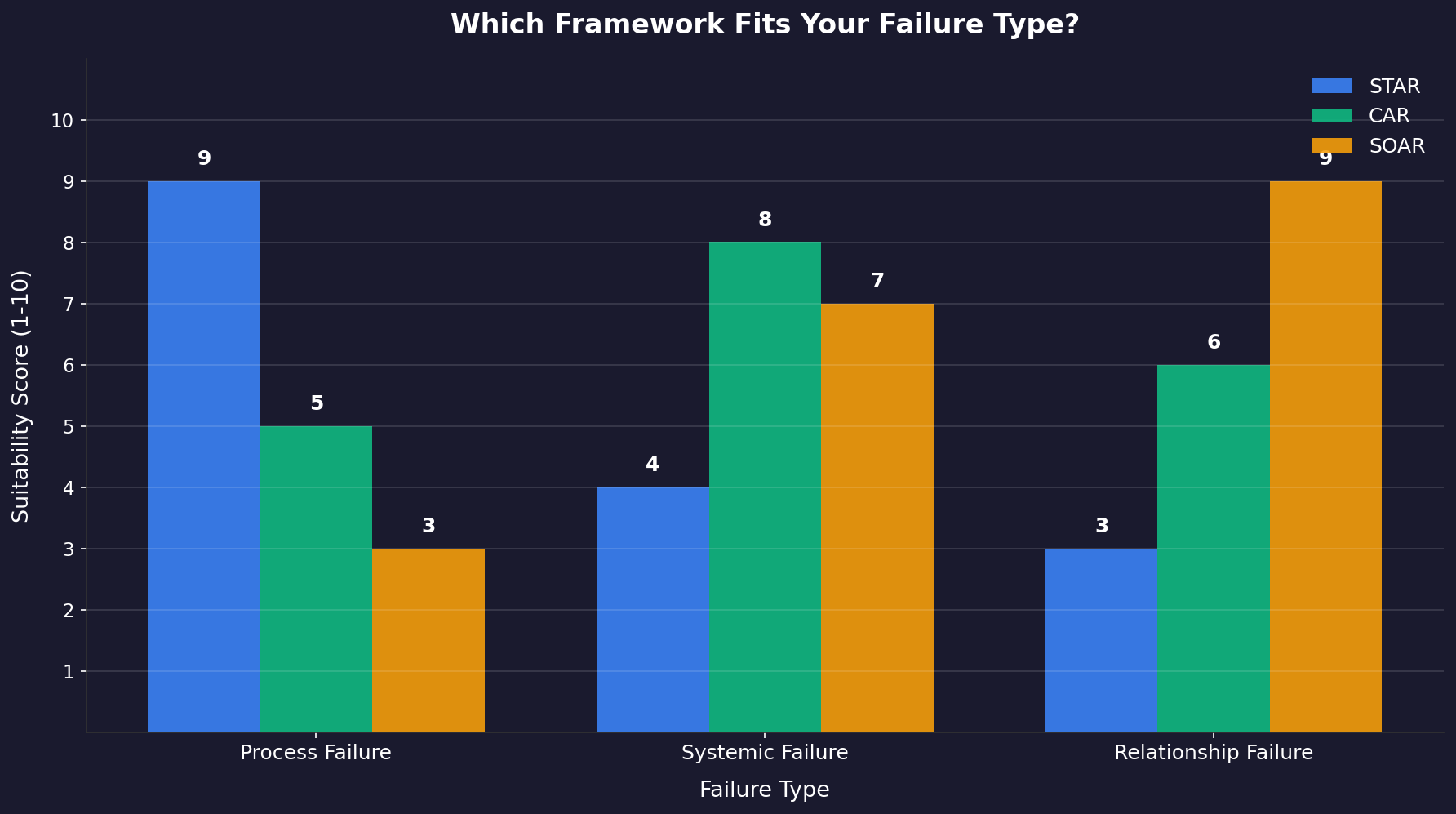
Three structures dominate interview coaching guides: STAR, CAR (Challenge, Action, Result), and SOAR (Situation, Obstacle, Action, Resolution). Each serves a different failure profile. STAR works best for process failures where the outcome was negative but recoverable. You missed a deployment deadline.
Situation: “Our team shipped 40 commits in five days without automated tests.” Task: “I needed to stabilize production by Friday.” Action: “I froze new features for 48 hours. And built regression tests covering 23 critical endpoints.” Result: “Zero incidents in the following two sprints.” CAR handles systemic failures with ongoing impact. A product launch flopped because market research skipped competitive positioning analysis. Challenge: three competitors released pricing tiers under your cost floor during pre-launch week.
Action: you pivoted messaging to focus on reliability metrics and retention guarantees rather than features customers couldn’t evaluate. SOAR is your weapon for relationship failures involving stakeholders or cross-functional teams. The obstacle distinguishes it from STAR—you name the specific friction that derailed progress.
Here is what kills every framework equally: skipping numbers. “We improved efficiency” is dead on arrival. “We cut approval wait time from 3.5 days to 11 hours across four departments” earns trust because specificity is hard to fake. One final trap catches many otherwise strong candidates: never end your failure answer with ambiguity about lessons learned. Close with exactly one behavior change you made afterward—the metric tracked differently, the checklist adopted permanently, or the escalation path rewritten.
Your closing sentence determines whether the recruiter remembers your story or discards it.
#
Matching the Framework to the Failure Type
The framework selection isn’t arbitrary—it’s a strategic decision based on what kind of failure you’re describing. Here’s a breakdown of when each structure shines:
STAR for Process Failures: Choose STAR when the failure happened inside a defined workflow with clear steps. A missed deployment deadline, a broken migration, or a failed code review all fit here. The Situation and Task provide essential context for why the process broke down. Interviewers can easily verify whether your corrective action addressed the actual process gap.
CAR for Systemic Failures: When the failure wasn’t a single event but a pattern—a product that missed market fit, a feature that users ignored, a strategy that underperformed—CAR keeps the focus on the challenge and your response. The absence of a Situation step works in your favor because systemic failures often have murky origins. You don’t need to establish a clean starting point; you need to show you recognized the pattern and acted.
SOAR for Relationship Failures: If your failure involved a stakeholder conflict, a cross-functional breakdown, or a communication gap, SOAR’s explicit Obstacle step is non-negotiable. The obstacle is the friction that made the failure inevitable—a product manager who withheld requirements, a design team that missed handoff deadlines, a vendor who ignored escalation emails. Naming that friction shows you understand failure rarely happens in isolation.
FAR for Compressed Follow-Ups: When an interviewer asks “What else?” or “Tell me about another time,” you don’t have time for a full setup. FAR—Failure, Action, Reflection—forces you to compress the story to its essential arc. This structure works best for backup examples you’ve already told once in the conversation.
#
Common Mistakes That Sabotage Strong Frameworks
Even with the right structure, candidates routinely undermine their own answers. Here are the four mistakes I see most often in mock interviews:
Mistake 1: Choosing a failure that wasn’t actually your fault. If your story involves a vendor who delivered late or a teammate who dropped the ball, the interviewer will wonder why you’re claiming it as your failure. Own something you directly controlled, even if it means admitting you should have escalated sooner or asked better questions.
Mistake 2: Ending with the repair, not the lesson. Fixing the immediate problem is table stakes. The interviewer wants to know what changed permanently. If your answer ends with “and then we restored service,” you’ve told a troubleshooting story, not a failure story. Add the system change, the process update, or the communication protocol you implemented afterward.
Mistake 3: Using the same failure for every prompt. If you tell the same story for “tell me about a time you failed” and “tell me about a time you had a conflict with a coworker,” interviewers will notice. Prepare at least three distinct failures from different contexts: a technical mistake, a strategic misstep, and an interpersonal breakdown.
Mistake 4: Over-rehearsing to the point of robotic delivery. You should know your stories cold, but you shouldn’t sound like you’re reading from a script. Vary your pacing, pause naturally, and let the interviewer see you think. The goal is prepared spontaneity, not memorization.
Strip Out the Fluff
One minute, forty-five seconds. That is your budget for the entire failure answer. Interviewers doze off by second twenty-five. You have no room for throat-clearing. Pack Situation and Task into 30% of your speaking time or less. Fifteen seconds for context: the project scope, your role, why it mattered. Then pivot hard into Action and Result, where the actual signal lives.
Cut every adjective that does not carry weight. Remove “tight deadlines,” “significant challenges,” and “valuable experience.” Replace them with concrete numbers: revenue lost, days delayed, customers impacted. The hiring manager wants to calculate how much trust to extend you. Give them data points they can actually evaluate.
Data transforms a mea culpa from melodrama into evidence. Replace “I felt terrible” with concrete specifics about impact. The first invites sympathy; the second invites a follow-up question about your recovery process. That’s where actual hiring decisions get made. The CAR framework works best for autonomy stories where you owned a decision. SOAR adds an explicit Obstacle step—important when you faced organizational pushback or conflicting priorities. FAR strips away Situation entirely: Failure, Action, and Reflection.
That three-step structure forces you to land on what changed permanently.
Meta interviewers track whether your reflection produced a new heuristic, not regret. One candidate described rebuilding their deployment checklist after a production outage and scored higher than peers who cited similar failures but stopped at “I learned to be more careful.” Map your story choice to the prompt carefully. A PAR response fits compressed follow-ups like “What else?” while SOAR covers conflicts involving stakeholders or competing deadlines. Mismatch the framework to the question and you’ll sound rehearsed rather than reflective.
#
The 90-Second Drill
Before any interview, run this drill with each of your three failure stories. Record yourself on your phone, then transcribe the audio. Count the seconds spent on context versus action versus reflection. If context eats more than 30% of the total, cut it. If reflection takes less than 15%, expand it. The ideal ratio: 30% context, 45% action, 25% reflection.
That split tells the interviewer you understand what matters—not what went wrong, but what you did about it and how you changed.
Tech Failures Speak A Different Language

Hiring managers want to see you prioritize root cause over blame assignment. Forward-looking measures matter most: mention adding Grafana dashboards for that specific metric or implementing circuit breakers with configurable thresholds in your service mesh configuration. Avoid describing heroics unless you also name the redundant processes they replaced.
Technical failures require a different vocabulary than general business failures. You can’t say “we had an outage” and expect the interviewer to understand the weight of what happened. You need to specify the blast radius: “Our payment API returned 503 errors for 14 minutes during peak checkout hours, affecting roughly 3,200 transactions.” That level of precision signals you understand the technical and business impact simultaneously.
When describing the root cause, be equally specific. “We didn’t have a circuit breaker on the inventory service” is better than “our architecture had a weakness.” The first names the exact missing component; the second sounds like a vague excuse. If you implemented a fix, describe it in operational terms: “I added a bulkhead pattern to isolate the database connection pool” or “I wrote a Chaos Monkey test that kills the cache layer weekly to verify failover.”
One distinction that separates strong technical failure stories from weak ones: whether you mention the monitoring gap. If your failure went undetected until a customer complained, say so. Then explain what telemetry you added to catch it earlier next time. Interviewers love this because it shows you think about observability, not just fixes.
Another differentiator: whether you can articulate the trade-off you made when choosing the fix. Did you accept a slower response time to gain reliability? Did you trade feature velocity for test coverage? Naming the trade-off shows you understand engineering is about choices, not perfect solutions.
#
What To Look For In Your Own Technical Stories
Before you pick a technical failure for your interview, run it through this checklist:
Was the failure caused by a decision you made, not a circumstance beyond your control? If the answer is no, keep looking. Interviewers want to see your judgment, not your bad luck.
Can you quantify the impact? You need at least one hard number: dollars lost, minutes of downtime, users affected, requests failed. If you can’t quantify it, you don’t understand the failure well enough to talk about it.
Did you implement a permanent fix? A rollback doesn’t count. You need a system change, a process change, or a monitoring improvement that outlasted the incident.
Can you explain the fix in one sentence? If you can’t, you’re still too close to the technical details. Distill it to its essence: “I added a dead-letter queue so failed messages don’t block the pipeline” or “I wrote a linter rule that flags missing timeout parameters.”
Practice, Don’t Perform
Record yourself answering three different failure questions on your phone. Watch for identical sentence patterns across responses. If your vocal tone flattens or your gestures become choreographed, you are performing, not communicating.
Test your answer on a teammate familiar with your technical stack. If they interrupt before you finish, you are drowning them in jargon. Run the same answer past a friend outside your industry. If they ask “but why didn’t you just…” after thirty seconds, your context layer is missing.
Prepare a backup example that demonstrates distinct growth: recovering from a syntax error versus repairing a broken sprint commitment. Each story should map to a different system change you implemented afterward—not just what went wrong, but how you ensured it wouldn’t happen again.
The practice phase is where most candidates fail. They rehearse the story in their head, convince themselves it’s ready, and then freeze when the interviewer asks a follow-up question. The fix is to practice under pressure. Set a timer. Have a friend pepper you with interruptions. Record yourself and watch the playback with a critical eye. The goal isn’t a perfect performance—it’s a flexible, adaptive answer that survives contact with a real interviewer.
One technique that works well: practice telling your failure story in three different time lengths. A 30-second version for rapid-fire follow-ups, a 90-second version for the main answer, and a 3-minute version for interviewers who want deep detail. Knowing you can compress or expand your story on demand gives you confidence that no question will catch you off guard.
That awkward pause when the failure question lands isn’t the real problem. The trap is defaulting to a safe, forgettable answer that wastes your only chance to prove growth. Every hiring manager looks for one thing: evidence you’ve done the hard work of introspection before this conversation. A polished story about missing a deadline won’t cut it. They need to hear how you reshaped your decision-making framework afterward.
Keep Reading
- How to Build Interview Feedback Scorecards That Actually Improve Hi…
- When Someone Asks “Tell Me About Yourself,” Say THIS (Not That)
- How to Answer “Why Do You Want to Work Here?” in Biotech Interviews
The strongest candidates don’t flinch at this question. They treat it as their best opportunity to demonstrate self-awareness and resilience in real time. What’s your story going to say about how you grow?