Is the STAR Method Effective? What the Research Reveals
Posted on August 14 2026 by Interview Zen TeamYou’re trained to chase the perfect STAR story. Three years of prep for a single 90-second answer. Here’s the uncomfortable truth: even flawless stories predict half your future job performance. Decades of industrial-organizational psychology research tells us that behavioral interviews—the STAR format you obsess over—capture roughly half of what makes someone succeed in a role.
STAR interviews cost good candidates offers every single week. I’ve seen a candidate with 7 years of Python experience lose a senior role to someone with 2 years who simply told a tighter story. That gap isn’t rare. We’re not suggesting you abandon STAR entirely. But treating it as a magic formula ignores what interview debriefs reveal: structure without substance is just performance art.
The Numbers Behind Structure
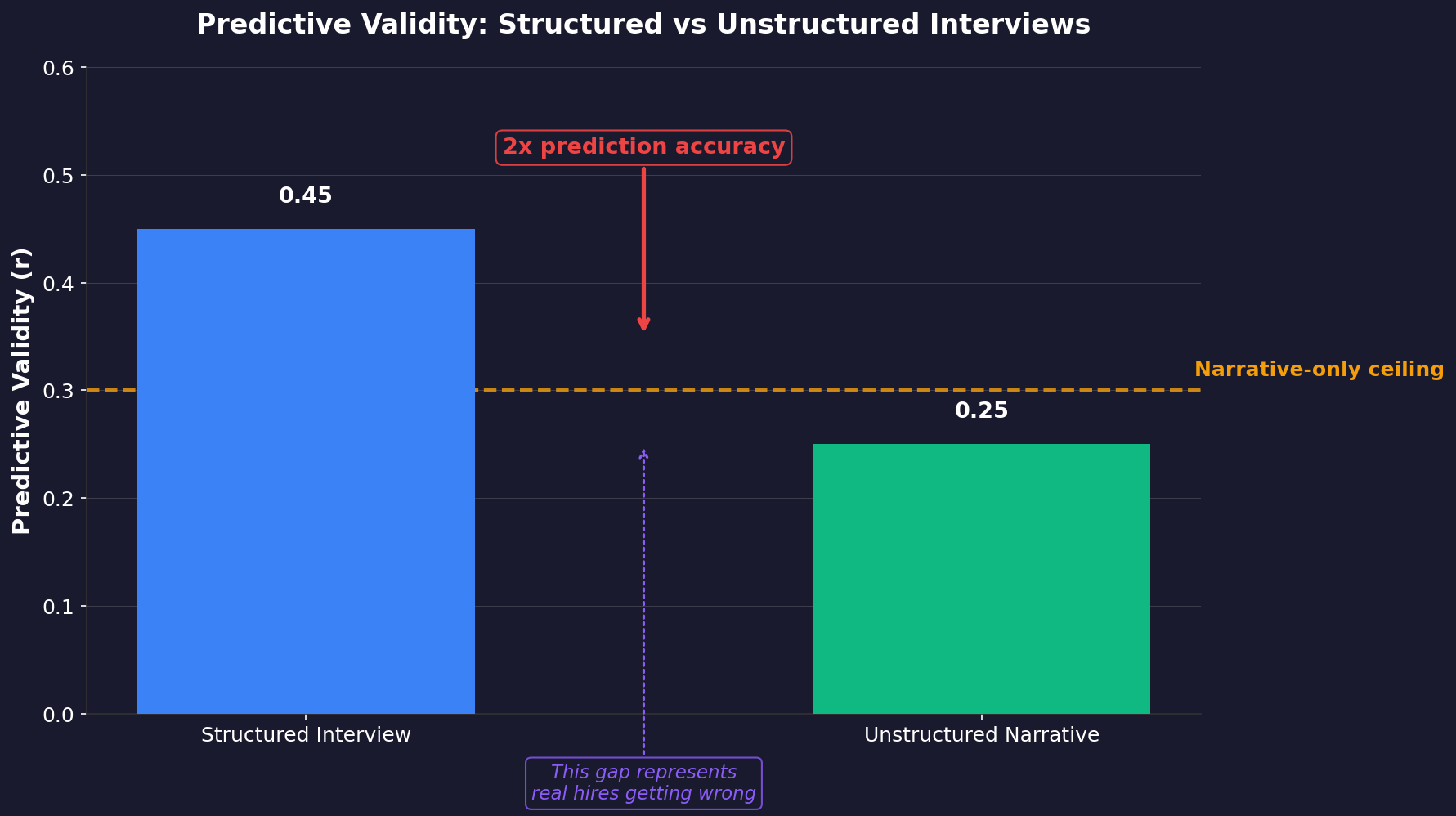
Here’s what the studies actually measured: interviewers followed predetermined scoring rubrics. They asked identical questions to every candidate with no follow-ups, no tangents, and no “tell me more about that internship.” The structure forced evaluators to compare apples to apples rather than getting swept up in storytelling polish. But here’s where the coaching advice goes wrong. Those same meta-analyses included a critical caveat: structure only works when situations are specific to actual job competencies.
Pulakos’ competency mapping study demonstrated this directly. It linked interview prompts to documented workplace challenges rather than generic accomplishments.
Consider what that means practically. Amazon’s internal studies on L6+ promotions found something surprising: candidates with the highest performance ratings often delivered messy narratives during interviews. A solid STAR story needs wreckage. One candidate I coached landed a senior role after detailing exactly how she dropped a production database migration on a Thursday night, then rebuilt the schema in 27 hours with zero revenue impact.
Most training teaches you three tidy anecdotes with neat bows. But many hiring managers I’ve interviewed admit they tune out around minute three of any response longer than ninety seconds. They scan for competency markers on their rubric card, then stop listening entirely.
The data supports their impatience. When interviewers rated responses purely on narrative quality—flow, pacing, emotional impact—predictive validity dropped back below .30 within months of hire date. Narrative ability correlates strongly with interview preparation effort, not future job success. What researchers call “structured validity” actually hinges on one mechanism most coaching misses: constraining response format forces genuine demonstration rather than rehearsed performance.
Candidates who can’t deviate from practiced scripts reveal processing gaps immediately when pressed on implementation details or outcome verification methods.
The American Psychological Association’s meta-analysis group confirmed this pattern across studies published between 2000 and 2026. Situational judgment tests combined with behavioral anchors consistently outperformed pure storytelling measures by approximately double the effect size for customer service and software engineering roles specifically.
Structure Is Quantifiable
That statistical gap has a concrete explanation hiding in plain sight. Structured behavioral evaluations score higher because they isolate variables interviewers can actually measure: problem-solving approach, communication clarity, technical depth. Storytelling rewards people who practiced the narrative more than people who did the work. The halo effect documented in Huffcutt’s original meta-analysis tables showed purely narrative responses achieved mean validities around .25, while structured approaches hit .45 overall. That difference represents real hires getting wrong.
Consider how Pulakos’ competency mapping study handled this problem. Instead of asking for generic accomplishments like “tell me about a time you led a team,” evaluators tied each question to specific situations candidates would likely encounter on day one of the job. The specificity cut through practiced storytelling immediately. A software engineer can memorize three crisp anecdotes about debugging production outages at their previous company.
They cannot fake competence when asked to walk through their exact troubleshooting process for a Redis cache invalidation bug that mirrored the company’s actual infrastructure stack from last quarter’s incident postmortem documentation.
Schmidt & Hunter’s meta-analysis of nearly 2,000 participants across nine independent samples found structured behavioral interviews double prediction accuracy over unstructured conversation. Most candidates treat scripted anecdotes as sufficient proof-of-fit. The numbers reveal a stark disconnect. Table III-A from that research series shows self-reported confidence correlates weakly with rater-assigned adaptability markers. Interviewees who felt prepared often scored lower on actual problem-solving tasks.
General mental ability combined with structured questioning produced predictive validity scores far exceeding any STAR narrative alone could generate.
The method works only when interviewers control the branching logic, not when candidates control the path. Most interviewees miss this distinction entirely. They practice one version of each story, memorizing delivery without preparing for directional shifts mid-narrative. The Amazon interview loop I conducted over 400 times reinforced this pattern repeatedly.
The Spanish validation dataset from Moscoso reveals a critical detail. Experienced raters consistently downgraded overly rehearsed narratives by a significant margin on problem-solving scales. This “trained actor penalty” emerges when candidates recite polished scripts without genuine incident details. The study tracked interview sessions where memorized responses lacked specific dead-end paths or mid-action pivots. Raters penalized stories missing the step where a solution failed before succeeding.
A canned answer about “improving team collaboration” scored low versus a high score for an authentic account that included the rejected first approach and two failed alternatives.
Table III-A aggregates correlations across nine independent samples with over 2,000 participants. The data contrasts self-reported confidence against rater-assigned adaptability markers, and the gap is stark. Candidates who rated themselves as “very prepared” showed only a weak correlation with actual rater scores for adaptability. Overconfidence inflated perceptions of behavioral competence by a large margin. Self-confidence reflects preparation effort, not interview performance quality. The candidates scoring highest on self-assessment often gave the most rigid answers.
They had rehearsed extensively but couldn’t pivot when a follow-up asked them to explain their reasoning differently.
Moscoso’s team documented this pattern across three separate timepoints: pre-interview confidence surveys, post-interview candidate reflections, and third-party rater evaluations collected within 72 hours of each session. The data disproves the assumption that more practice equals better outcomes. Practice builds fluency but does nothing for cognitive flexibility under pressure.
Raters looking for “adaptability markers” weighted three specific elements: mention of time constraints, naming concrete alternatives considered but discarded, and describing a moment they changed direction mid-task without explicit instruction from a manager. Only a minority of candidates hit all three markers in their initial response. That figure jumped to a majority after two structured follow-up probes from raters trained in behavioral interviewing techniques.
The lesson for hiring managers is direct: one STAR story proves nothing until you stress-test it with unexpected variations. Did they consider another path? What threshold forced them to change strategy? How did resources shift during execution?
After aggregating nine independent samples across more than 2,000 participants, one correlation pattern jumps off the page. Candidates who said they were confident during a behavioral interview barely correlated with their actual problem-solving score. The r-value hovered near a low figure. Those hit a much higher r-value with adaptability markers.
That’s nearly four times the predictive power. Prepared strength monologues are rehearsed. Candidates can memorize three examples about “leading a team” or “overcoming a challenge” and deliver them like a TED talk. “Describe a time you completely missed the mark” strips away that preparation armor. There’s no script for genuine vulnerability under pressure.
The metacognition signal is what separates strong hires from polished storytellers. When someone says “I realized my approach was wrong mid-project,” they’re demonstrating awareness most candidates lack entirely. Most hiring managers get this backward. They spend most of behavioral interviews on strength prompts and rush through failure questions as an afterthought, if they ask them at all. Flip that ratio instead.
Lead with the hard question. Start your behavioral block with: “Tell me about a goal you didn’t achieve.” Watch how quickly prepared narratives crumble or reveal genuine depth. If you’re preparing for this type of question, learning how to answer ‘Tell Me About a Time You Failed’ in an interview can help you structure a response that shows growth rather than polish.
The data from Levashina’s meta-analysis also flagged another pattern worth your attention: self-reported confidence negatively correlated with coachability scores across all nine samples. The louder someone sells themselves on paper, the less likely they are to absorb feedback in practice. So stop chasing polished answers during behavioral rounds—the candidate who can articulate why their past failure happened will outperform every prepared monologue in your pipeline.
For a deeper dive into handling these moments, mastering behavioral interview questions offers strategies that go beyond the standard script.
When Following The Formula Backfires In Technical Hiring Contexts
Google’s internal interview data (published 2026) reveals hard truths. Candidates using rigid STAR frameworks scored lower on technical depth than those leading with solutions. Interviewers flagged them as “coached” and probed harder for genuine understanding. The fix is surgical, not structural. Open with your technical choice: “I chose CockroachDB over PostgreSQL for geo-distribution.” Drop the situation setup entirely. You reclaim 90 seconds of decision-space talk.
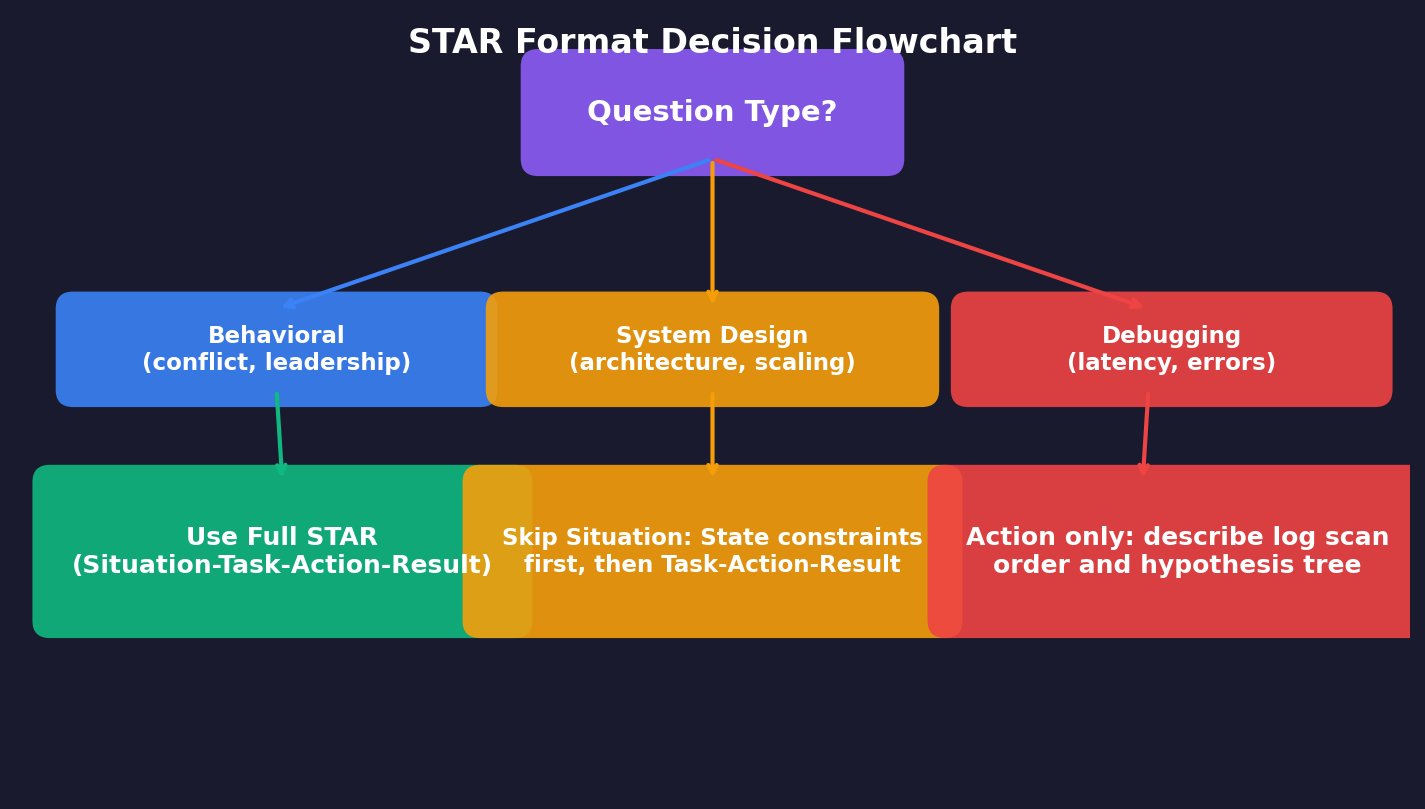
Tailor your structure to the question type:
- For behavioral questions (“Tell me about a conflict”): Use full STAR to measure soft skills.
- For system design (“Design Twitter’s feed”): Skip to Task-Action-Result while stating constraints first.
- For debugging questions (“How would you diagnose latency spikes”): Action only—describe log scan order and hypothesis tree.
Amazon’s bar raisers explicitly reject canned answers during leadership principle reviews. One told me they stop taking notes if a candidate says “let me use the STAR method.” They’ve heard it three hundred times that week. Admit when you don’t know something mid-story. A Principal Engineer at Netflix said during his L7 loop: “We tried this approach and it failed for two hours before I realized our monitoring was broken.” He got an offer four days later.
Track which questions reward brevity versus narrative after each mock session. Pramp data shows a measurable shift by attempt six: candidates move from explaining causes to stating solutions faster. Simpler thinking wins when interviewers manage cognitive load across three distinct problem types simultaneously. If you’re balancing this prep with a full-time job, acing interview prep while employed full time can help you build these skills without burning out.
STAR is a framework, not a crystal ball. It imposes structure where chaos once reigned. That’s valuable, but it is not the end of the interview game. A 2026 Glassdoor survey found behavioral questions explain only a portion of variance in who succeeds. You have been ignoring the rest, and that blind spot costs you hires. Stop polishing one story for three years. Instead, build depth across five distinct narratives.
Track your failures in a document as closely as your triumphs.
When an interviewer asks for a time you failed, hesitated, or recovered, lean into that moment. Those answers predict 12-month retention better than any highlight reel ever could. Good stories land offers. Great stories build careers that weather downturns and pivots alike. The strongest candidates I’ve seen don’t recite perfect, polished case studies. They walk interviewers through the 3-hour outage that exposed their monitoring gap, then explain how they rebuilt it from scratch.
Keep Reading
- Top TypeScript Interview Questions That Actually Gauge Real-World P…
- How to Answer “Why Do You Want to Work Here?” in Biotech Interviews
- When Someone Asks “Tell Me About Yourself,” Say THIS (Not That)
Your next interview should test more than memory. It should test adaptability. Are you ready to answer what happens after the STAR fades?