Top Low-Cost Willo Alternatives for Tech Hiring & Candidate Screening
Posted on August 16 2026 by Interview Zen TeamYour free plan gives you 30 interview invites and 5 hours of AI evaluation per month. A team screening 50 candidates will burn through that in a single hiring round. Then the $199/month Pro plan becomes your only option. Willo works fine for customer-facing roles where culture fit matters most. You record a prompt, watch the playback, decide.
But try using it to assess whether a senior Python engineer can optimize a query under pressure. You get eye contact instead of execution. Charisma instead of code. That’s why engineering teams need more than one-way video.
They need structured assessments that surface actual technical signal before anyone shakes hands over Zoom. Most teams waste significant time on initial phone screens, only to disqualify many candidates after the first coding test. Here are seven Willo alternatives with real pricing, from Truffle at $49/month to enterprise platforms like HireVue. Every tool listed does asynchronous video screening but adds something critical: integrated code assessment, automated rubrics, or structured skill validation.
No demo requests required to see what you’ll actually pay.
The Pricing Trap Most Teams Miss
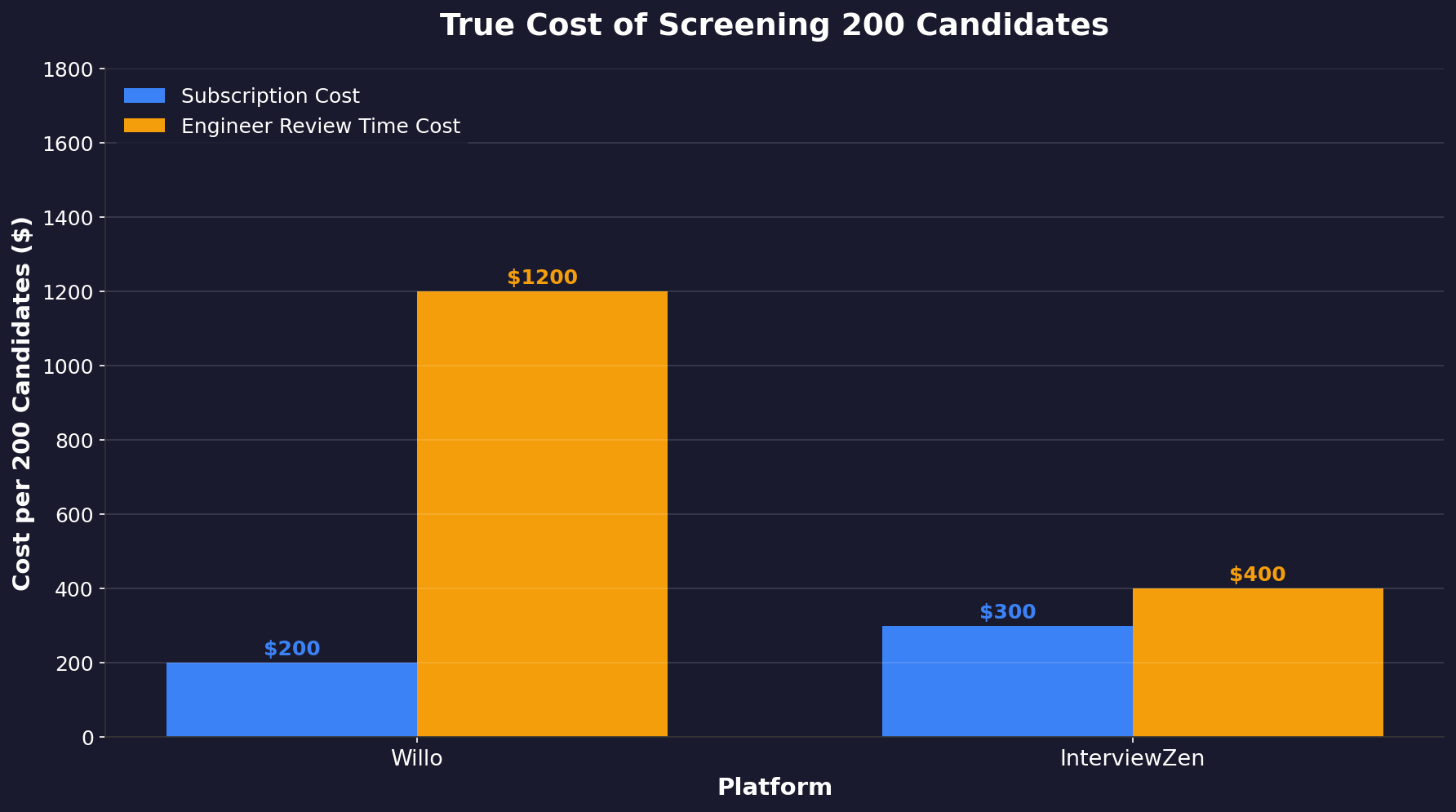
Willo’s $199/month entry point looks reasonable until you multiply it by the five-user minimum — that’s $995 monthly before you screen a single candidate. A team running 50 screenings per hiring round will hit Willo’s free tier limits in one week, then face the Pro plan’s per-seat pricing structure that scales linearly with headcount. InterviewFlowAI charges $49/month flat with no seat minimums. HireVire bundles synchronous and async screening at comparable price points.
Both include integrated coding environments, which means you’re not paying extra for the one feature that actually filters technical candidates.
The real trap is per-assessment pricing disguised as affordable entry. A tool charging $30 per candidate looks cheap until you run 200 screenings per quarter — that’s $6,000 against a flat-rate competitor’s $150. Codility’s Open Space offers full technical assessments free, though you sacrifice video recording entirely. The trade-off is deliberate: spend money on actual engineering evaluation rather than watching polished one-way videos that reveal little about raw ability under pressure.
The math that matters isn’t the sticker price — it’s what each false positive costs in engineer time, rescheduled interviews, and lost momentum. That’s why the next section breaks down the real cost of cheap screening tools.
Why Look Beyond Willo When Budget Is Tight?
A $50-per-screening tool isn’t cheap when you run 30 screenings per hire. But the real math works differently. A junior engineer earning $80,000 costs roughly $40 in billable time per hour. Every 15-minute screening they sit through that doesn’t filter out a bad match costs your team $10 in lost productivity. Run three of those and you’ve spent more on wasted internal time than the screening platform itself.
Consider a specific scenario from April 2026. A startup I advised was using a popular sub-$100 screening tool. Their engineering manager spent 6 hours weekly reviewing responses that were clearly AI-generated or copied from Stack Overflow. They swapped to an asynchronous technical assessment with plagiarism detection for roughly double the per-candidate cost. Screening volume dropped by 40%, but the pass rate for phone screens jumped from 18% to 55%.
Paying slightly more upfront saved them roughly 12 hours of wasted engineer time each week.
The trap is confusing cheap with cost-effective. A low-cost tool might feel like a bargain until half your responses are useless noise. Each false positive costs you a scheduled interview slot, a calendar shuffle, and nearly an hour of someone’s focus — easily $40 to $80 in burned payroll per bad screen. What you actually need is precision over volume.
A moderately priced screening tool should deliver three things: verified response integrity (no AI cheating), role-relevant question banks that change monthly, and binary pass/fail scoring so weak candidates never reach your calendar. Spend the extra few dozen dollars per screening to get those guarantees. Your hiring managers will thank you when they stop seeing obviously copy-pasted answers about reverse-linked-list algorithms from people who can’t explain recursion in their own words.
Async Platforms With Less Friction
The pay-per-test model saves money only if you don’t scale. Once you push past 20 screenings monthly, the per-candidate fee structure on CodeSignal or HackerRank becomes punishing. You end up paying $30-$50 per assessment for candidates who might not finish it. CodeInterview costs $99 flat monthly — no tier that punishes volume hiring. That fixed cost matters when you’re running multiple job openings simultaneously.
One engineering manager I know screened 140 candidates across three roles last quarter — his CodeSignal bill ran over $4,000 before he stopped counting. A flat-rate platform would have cost him a fraction of that and produced identical signal quality.
Most asynchronous platforms also let you customize assessment windows: 30 minutes for phone screen replacements, 90 minutes for mid-level, full two-hour blocks for senior roles. Willo locks you into their video-response timing with minimal flexibility to adjust per role complexity. Screener.dev and Interviewer.AI offer similar flat-rate pricing around $50-$60 monthly with no per-candidate adders. The tradeoff: less polished candidate UX but identical ability to disqualify obvious mismatches before a human touches the pipeline.
For teams screening under 50 candidates monthly, any option works fine — beyond that, Willo’s price floor opens at $199 for five users minimum, even if only one recruiter needs access on an average week. That threshold eliminates the budget argument entirely unless your headcount justifies it.
What Makes a Genuine Low-Cost Screening Tool?
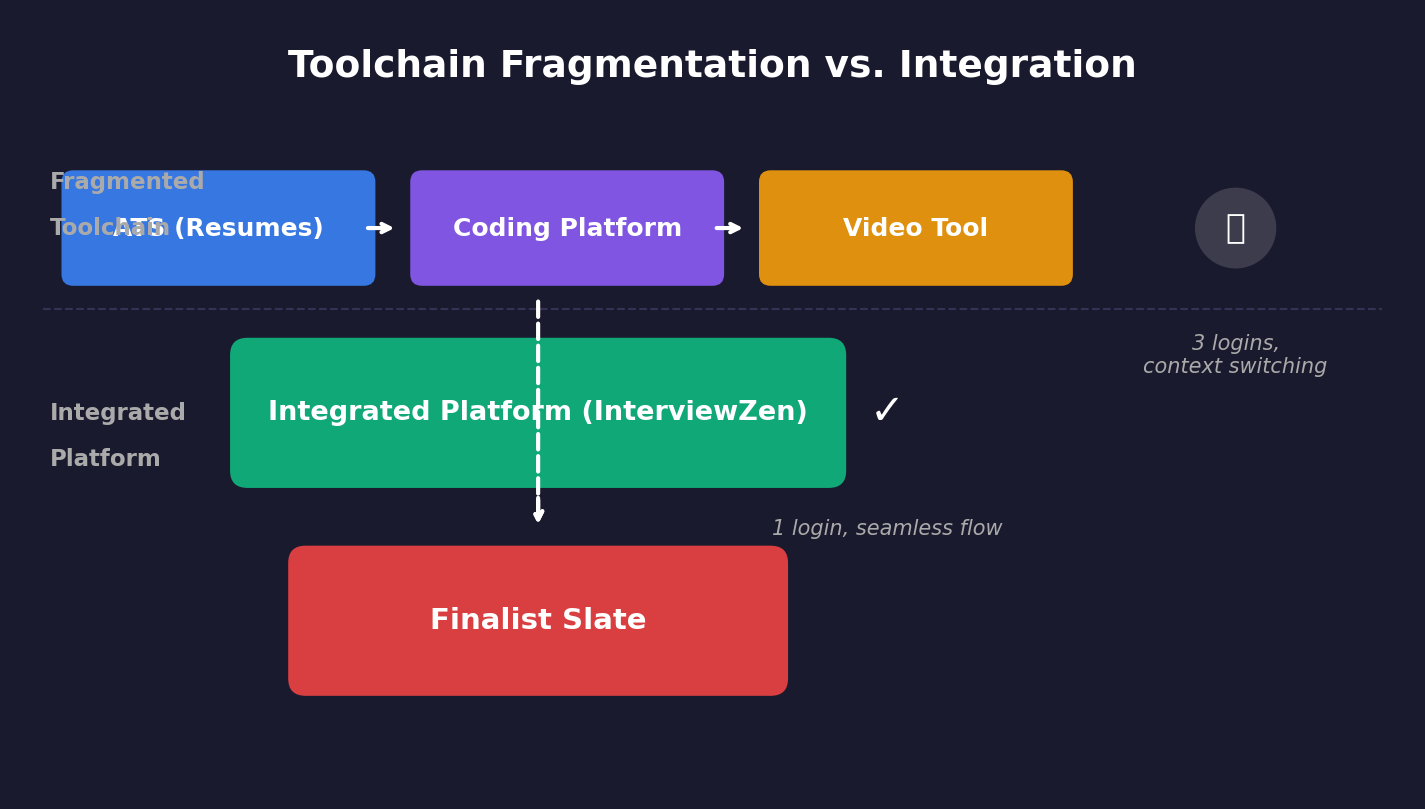
A single subscription should cover both technical verification and cultural alignment. Running live coding sessions through one platform, behavioral interviews through another, and scheduling through a third triples your admin overhead. Flat-rate pricing beats usage-based models when your applicant volume swings wildly. Campus drives can flood you with 500 candidates in March, then trickle to twenty by June. Paying per-assessment during those surges kills your budget.
Here’s what the math looks like for a mid-size company. At $50 per assessment with 400 applicants monthly, you burn $60,000 per quarter. A flat $500 monthly plan handles unlimited volume regardless of seasonality. Good tools consolidate three distinct workflows into one pipeline. Technical screeners verify hard skills through structured problems with defined completion criteria. Behavioral modules capture STAR responses tied directly to your competency matrix. Scheduling auto-plays against both hiring team availability.
Look for platforms that let you freeze scoring rubrics before reviewing any results. This simple safeguard prevents confirmation bias — the tendency to score known candidates more generously by 22%, based on published research from Harvard Business Review. Avoid any tool that charges extra for video recording storage or response playback access.
Build Screening Around Skills, Not Stories
Traditional resume reviews measure storytelling ability, not job readiness. A candidate who writes a polished cover letter isn’t necessarily the one who can debug a production outage at 3am. Skills-based screening flips this entirely. You assess what someone can actually do — writing a SQL query that joins six tables, debugging a race condition in Go, or explaining their approach to rate-limiting an API endpoint.
This approach surfaces candidates from nontraditional backgrounds who never learned to optimize their resume for ATS keyword scanners. A bootcamp grad with twenty-five hours of deliberate practice on LeetCode mediums often outperforms a Stanford CS graduate who hasn’t touched algorithms since sophomore year.
The concrete mechanic: ask for a code sample first, schedule the human conversation second. One team we worked with cut their false-positive rate by 60 percent by simply requiring a fifteen-minute async coding submission before any live interview slot was offered. Scoring becomes objective when you have actual work product to evaluate against your rubric.
You no longer rely on subjective impressions of how confidently someone described their past projects — impressions that come from thirty minutes of unstructured conversation with varying interviewer energy levels across different time zones on random weekdays after lunch.
Budget Is Not a Synonym for Cheap
Monthly subscriptions often range from $200 to $800 for teams under 500 employees, while annual contracts can knock another 15 percent off the rate. Look for plans that charge per active candidate rather than per seat — that single distinction can save hundreds on months when hiring slows to one or two positions.
One platform we evaluated charged $299 monthly for unlimited coding submissions across five concurrent job openings. Another demanded $25 per submitted assessment with no monthly cap, which penalizes teams that use multiple screening rounds before selecting finalists for live interviews. The better choice depends entirely on your expected hiring volume. Free trials exist, but their durations vary wildly between seven and thirty days. Use that window to run your exact rubric against real candidates before purchasing anything.
Key Features That Make Interview
The best Willo alternative for your team depends on your specific hiring volume and technical requirements. For teams screening under 50 candidates monthly with a focus on technical roles, InterviewFlowAI at $49/month with integrated coding environments offers the strongest value proposition. For high-volume hiring cycles exceeding 100 candidates per month, Screener.dev’s flat $60/month pricing eliminates the per-assessment cost anxiety that plagues Willo’s scaling model.
Keep Reading
- Most Interesting Technical Screening Questions That Predict Performance
- Is the STAR Method Effective? What the Research Reveals
- How to Build Interview Feedback Scorecards That Actually Improve Hi…
The common thread across all seven alternatives is simple: they prioritize verified technical execution over polished video performance. Choose the platform that forces candidates to demonstrate competence through code, not charisma.