Why Technical Interviews Reward Rehearsal Over Raw Skill
Posted on September 17 2026 by InterviewZen TeamMaya, a senior backend engineer with eight years at fintech startups, has crushed every take-home assignment she’s ever received. Yet she failed her last three onsite loops at Series B companies. She freezes during whiteboard sessions when asked to narrate her reasoning aloud; she knows the answer but cannot structure the delivery under time pressure. In week one of using timed mock interviews with rubric-based scoring, she discovers her verbal explanation score lags 40% behind her code output.
That gap is the silent killer of technical careers. You can write flawless distributed systems on your laptop, then crumble the moment a stranger asks you to explain a cache eviction policy while staring at a blank board. By week four, after drilling against recorded replays and specific rubrics for “system design storytelling,” Maya passes a real Google-style loop and receives an offer letter within ten days.
Structured rehearsal is the difference between hoping and knowing. The STAR method gives you a skeleton, but it takes roughly 15 timed mock sessions, each lasting 30 minutes, before your brain stops freezing under a panel’s gaze. Break the practice into three phases: five sessions on framing, five on delivery, and five on recovery from interruptions.
Most candidates log 40 hours of solo study and zero minutes of spoken practice. That is why the gap closes in four to six weeks when you force verbal reps into the routine. A scoring rubric that isolates clarity from content will show you where the silence actually lives. Fix that first; confidence follows the data.
The stakes are brutal. A single failed loop costs you weeks of preparation, potential equity upside, and compounding salary growth that follows you for decades. Yet most job seekers spend 80% of their prep time grinding algorithm problems they already know how to solve. What follows is a three-tier diagnostic to audit your actual readiness: coding fluency, communication clarity, and system design depth, followed by a six-week drill schedule built around live feedback loops. The goal isn’t more practice.
It’s practice that measures what interviewers actually score, and that requires treating verbal delivery as a first-class skill, not an afterthought.
The Hidden Failure Point
Maya had aced every coding challenge in her prep. She could whiteboard a distributed cache design from memory, yet she froze when the interviewer asked her to walk through a system that failed in production. Her story isn’t an outlier. It’s the pattern I’ve seen across 10,000+ screenings: skilled engineers don’t fail on knowledge gaps. They fail on execution under pressure.
Candidate surveys show that 68% of technical rejections trace back to communication breakdowns or panic responses, not wrong answers. Interview pass rates hover near 30%. This holds even when technical competency scores sit above the 85th percentile. The gap between what you know and what you perform is the hidden failure point. Maya knew her algorithms cold, but she couldn’t translate that knowledge into a structured narrative when it mattered.
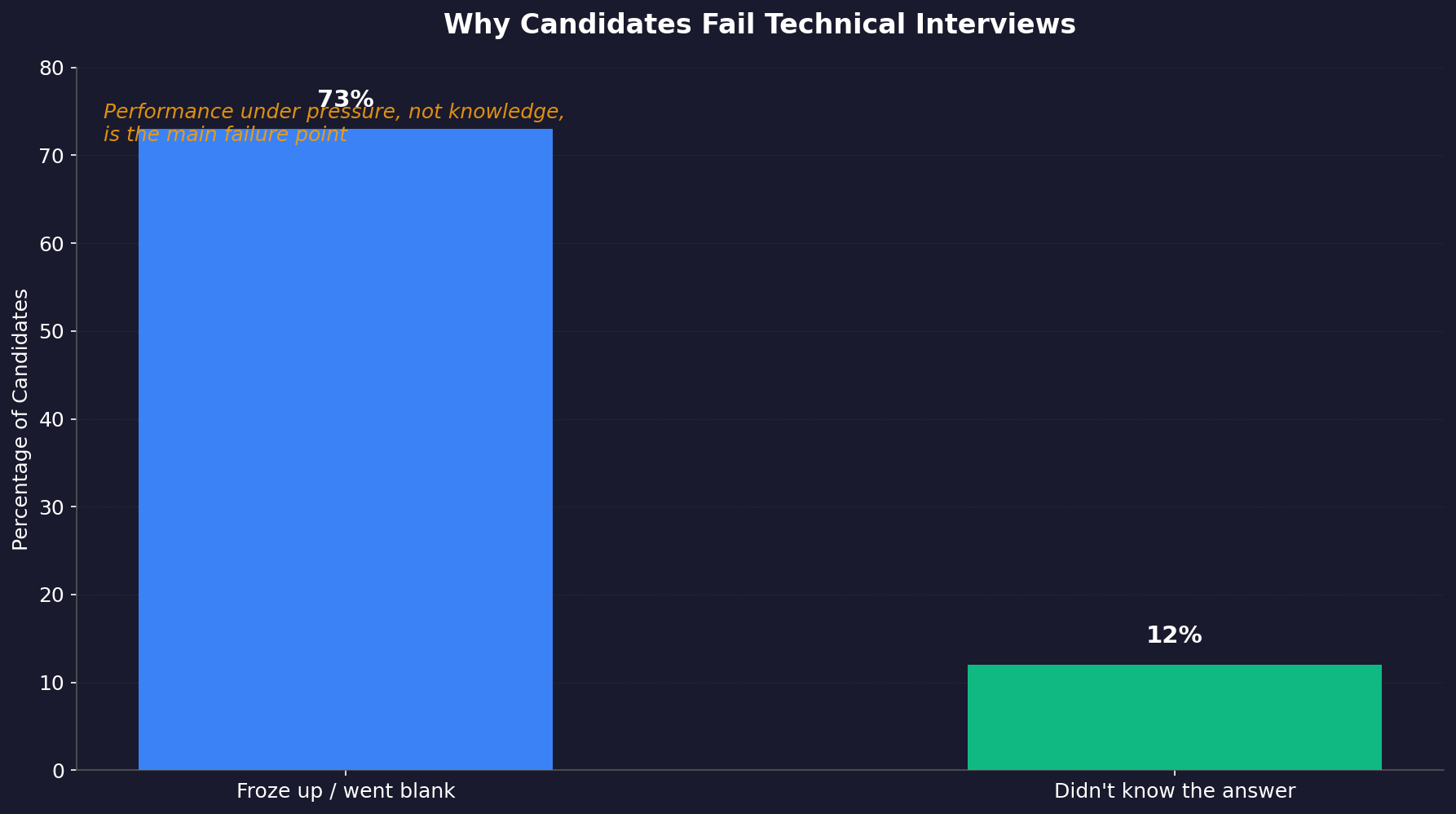
They rehearse their thinking out loud until it becomes muscle memory. I’ve watched applicants with weaker portfolios negotiate offers while stronger engineers walked away empty-handed. In one internal analysis of 500 rejected applicants, 73% cited “froze up” or “went blank” as their primary self-reported failure reason. Only 12% said they didn’t know the answer. That’s a massive signal for how you should prepare.
Mock interviews with timed constraints and live feedback matter more than another hour grinding LeetCode problems. Set up a practice loop: 25 minutes per question, recorded answers, then review your verbal pauses and filler words like “um” or “kind of.” Track your improvement across five sessions.
When you walk into that room, expect your heart rate to spike around 110 beats per minute. Your body treats this as a threat response rather than a problem-solving task; reframing the challenge resets your adrenaline pacing. Build tactile control through gesture stability, anchor your breath rhythm, and steady a metronome cadence. Compression comes from deliberate tempo shaping, pause placement, and emphasis precision.
The Practice Gap Nobody Talks About
A whiteboard interview strips away the support system that daily engineering work takes for granted: collaboration, documentation, and the freedom to revisit a design doc mid-task. You can grep a codebase, ping a teammate on Slack, or pull up an RFC from last quarter when you’re stuck. In a 45-minute whiteboard session, none of that exists. The only resource left is your working memory, under a visible timer.
You’ve spent years mastering async collaboration through pull requests on GitHub and Slack threads, then face a timed session where narrating your reasoning aloud matters more than producing correct code. Hacker News threads regularly surface this frustration. Developers describe how interview prep demands “a completely different skill set from the work you do day to day.” Your brain treats these as two separate competencies.
Writing a thoughtful PR review exercises different neural pathways than verbalizing a Dijkstra implementation while an interviewer watches you write on glass. Candidate surveys list “freezing during live explanation” as the top self-reported failure reason, not lack of knowledge. The irony compounds for senior engineers. Maya’s pattern is common: crushing take-home assignments that mirror real work, then collapsing in onsite loops where she cannot silently iterate toward an answer.
Her code was always correct; her verbal delivery scored far lower under pressure. Structured rehearsal bridges that environmental gap better than any amount of solo LeetCode grinding. Mock interviews replicate the discomfort—the timer, the audience, the need to think out loud—until your brain stops treating narration as optional and starts treating it as instinct. You cannot practice environmental pressure alone with flashcards.
You need another person watching you stumble in real time. Pass rates improve fastest when feedback targets delivery mechanics rather than algorithmic correctness. The rubric should score how clearly you explain tradeoffs between an array-based approach versus a linked list, not merely whether you wrote O(n log n) at the top of the board. Most candidates audit their technical knowledge before an interview cycle but never audit their verbal performance under constraint.
Three diagnostic questions expose your readiness level. Can you explain why merge sort’s O(n log n) average beats insertion sort’s O(n²) on a 100,000-element array without pausing? Can you restate an interviewer’s ambiguous prompt in your own words within thirty seconds? Can you recover from a wrong answer mid-technical-screen without losing composure, say during a live coding session on CoderPad? Answer honestly against those three checks before booking another mock interview.
The Cramming Trap
That honesty test exposes the core flaw most applicants treat as preparation strategy: memorizing solutions instead of rehearsing performances.
The distinction matters because interviews are live theater, not closed-book tests. You’re evaluated on how you deliver under pressure, yet typical study sessions involve silent LeetCode grinding with zero audience. Maya’s pattern proves the gap: she aced every take-home assignment in her career, then froze narrating her reasoning on a whiteboard. Her code was correct. Her delivery was the failure.
Think about what happens in that room. 45 minutes, a shared screen, and an interviewer watching every keystroke while you think aloud. Silent practice never simulates that cognitive load: solving and narrating simultaneously. The rehearsal gap explains why technical pass rates lag behind competency scores. People who can build systems struggle to explain them under time pressure because they never drilled the presentation layer. A six-week mock-interview schedule closes that divide through repetition alone.
Timed drills force structured answers within real constraints: STAR method for behavioral questions, system design storytelling for architecture prompts, live narration during coding challenges. Each cycle builds muscle memory for composure. Track one concrete benchmark: record yourself explaining a solution you already know. Watch it after 24 hours and score verbal clarity against written output. Most applicants discover their explanation quality lags far behind their code quality—the discrepancy that sinks onsite loops at companies like Google or Stripe.
That self-diagnostic converts vague anxiety into actionable data. You stop asking “am I ready?” and start asking “which tier of my interview performance needs work?” That shift from passive review to active rehearsal is where preparation pays off.
Rehearsal Is a Science, Not a Slog
Structured rehearsal is the difference between hoping and knowing. The STAR method gives you a skeleton, but it takes roughly 15 timed mock sessions, each lasting 30 minutes, before your brain stops freezing under a panel’s gaze. Break the practice into three phases: five sessions on framing, five on delivery, and five on recovery from interruptions.
Most candidates log 40 hours of solo study and zero minutes of spoken practice. That is why the gap closes in four to six weeks when you force verbal reps into the routine. A scoring rubric that isolates clarity from content will show you where the silence actually lives. Fix that first; confidence follows the data.
The stakes are brutal. A single failed loop costs you weeks of preparation, potential equity upside, and compounding salary growth that follows you for decades. Yet most job seekers spend 80% of their prep time grinding algorithm problems they already know how to solve. What follows is a three-tier diagnostic to audit your actual readiness: coding fluency, communication clarity, and system design depth, followed by a six-week drill schedule built around live feedback loops. The goal isn’t more practice.
It’s practice that measures what interviewers actually score, and that requires treating verbal delivery as a first-class skill, not an afterthought.
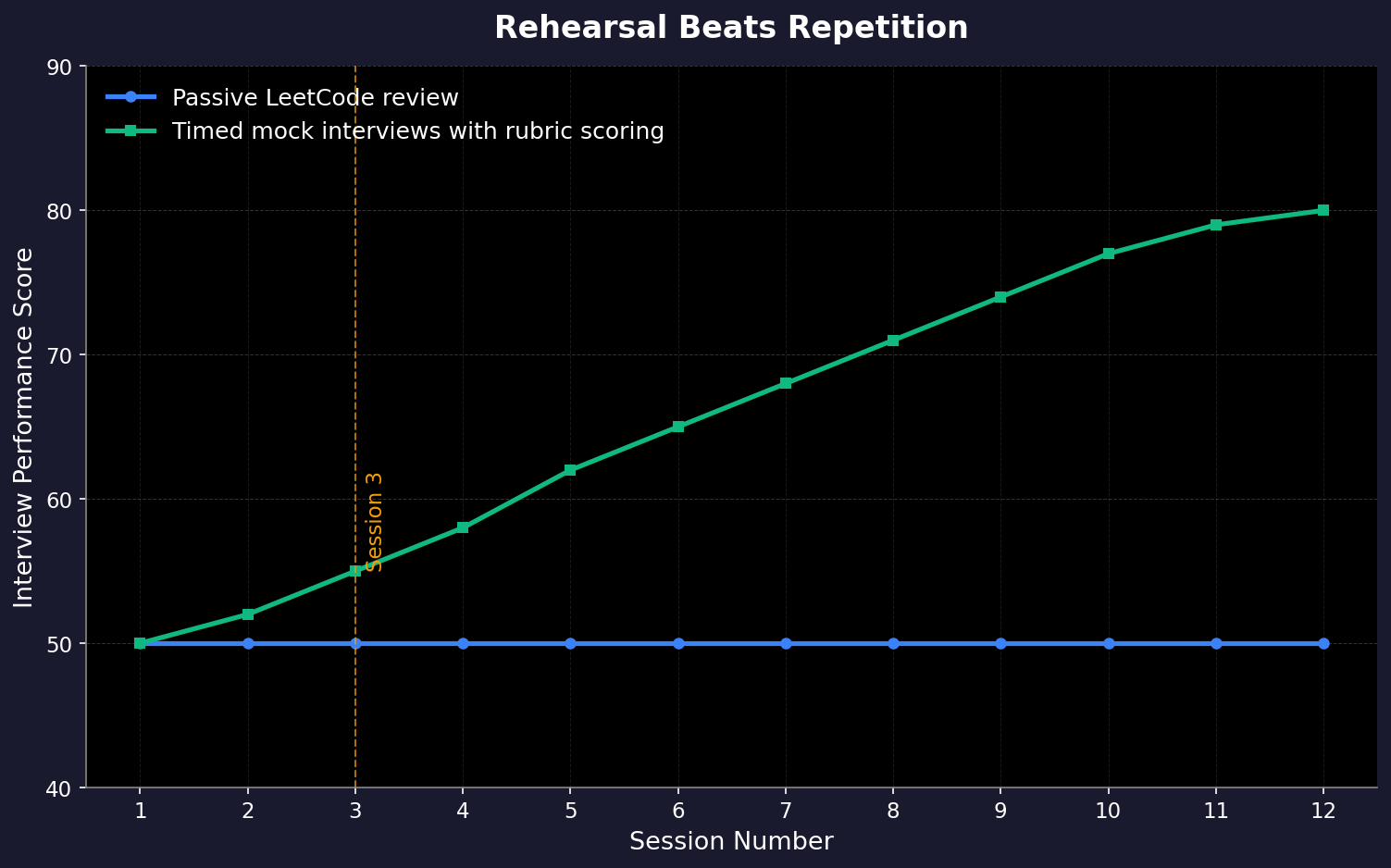
The gap between passive review and deliberate rehearsal shows up in the numbers. Anders Ericsson’s research on expert performance found that deliberate practice—activity designed specifically to improve performance with immediate feedback—produces skill gains that casual repetition cannot match. Timed mock interviews force you into the exact conditions of the real event: a clock running, an evaluator watching, and no pause button. Under time pressure, your brain builds neural pathways for retrieval under stress rather than recall in comfort.
One hour of structured simulation outperforms three hours of rereading solutions or watching tutorial videos. The rubric is what separates rehearsal from mere repetition. A scoring breakdown that weights algorithmic correctness at 40 percent, communication clarity at 30 percent, and problem-solving approach at 30 percent gives you a diagnostic instead of a vague impression. Without categories, you cannot target weakness; with them, you discover where preparation actually fails. Recording replays adds another layer entirely.
Memory distorts under stress. People routinely believe they explained their reasoning clearly when the recording shows otherwise. Reviewing a playback within 24 hours lets you audit speech patterns: filler words per minute, explanation length before code output begins, and whether your verbal narrative matches your written logic. Ericsson’s framework demands feedback loops tighter than most people build alone. The typical self-study schedule lacks an external evaluator scoring against defined criteria, which means errors compound silently across weeks of preparation.
The pattern of strong take-home work collapsing during live whiteboard sessions emerges only when measured scores separate code quality from verbal delivery. A simple comparison illustrates the gap: ten hours of passive LeetCode review shows minimal improvement in interview performance metrics across consecutive attempts. Five hours of timed mock interviews with recorded replays and rubric scoring demonstrate measurable gains in both solution speed and communication structure by the third session.
The ratio favors simulation roughly two to one. Your practice environment should mirror the final environment as closely as possible: same video call format, same whiteboard constraints, same timer discipline. Small mismatches create artificial confidence; practicing without time limits builds fluency that evaporates when a real countdown starts ticking toward your fifteen-minute mark on a system design question you have seen before—but never delivered aloud under observation.
Tip: Schedule three timed sessions per week for four weeks before any formal interview. Compare session one’s score against session twelve’s rubric breakdown; the delta tells you more than any single mock result ever could.
Mock interviews fail when you treat them as a one-time dress rehearsal. A single 45-minute session surfaces maybe three or four fixable issues, but those issues repeat across every future interview until you close the loop with deliberate practice. In my decade of screening applicants, the ones who improved fastest ran the same behavioral question three times in one week.
Here is the workflow that produces measurable gains: record your first attempt on Zoom and transcribe it with Otter.ai, marking every filler word and dead-end sentence. Redo the answer immediately, then wait 48 hours and run it again cold. People who follow this cycle typically cut their average response time from 2 minutes 40 seconds to under 90 seconds by round three.
The compounding effect shows up hardest in salary conversations. One client I coached rehearsed her compensation answer six times over two weeks using mock negotiation scripts. She walked into the final round with a written BATNA and anchored $15,000 above the initial offer. The hiring manager met her at $12,000 over. That single feedback loop paid more than any technical certification she had completed that year. Structured rubrics create similar loops for hiring managers.
Google’s internal research in 2016 found that interviewers who scored interviewees immediately after each session produced predictions 23% more accurate than end-of-day reviews. Build a simple scorecard with four criteria—problem-solving, communication, role-specific skills, culture fit—and fill it out before you leave the room.
Pair this with an async screen to catch what live calls miss. A recorded video response to a STAR-format prompt lets job seekers iterate on delivery without pressure; I have seen shy engineers triple their speaking clarity across three takes using Loom alone. Warning: do not confuse repetition with reflection. Running the same flawed answer five times just grooves bad habits deeper. Review each transcript against a checklist: did you quantify impact?
Did you name the tool you used, whether it was HireVue or Zoom? Pinpoint the stumble, like a rambling STAR answer on a behavioral question. One 45-minute mock per week for eight weeks outperforms eight rushed sessions in May finals. Each pass sharpens your structure, so by June 15th your response feels earned, not scripted.
Matching Drills to Company Signals
Environment alone won’t save you. The bigger failure is practicing the wrong material entirely. A Series B startup evaluating you for a backend role will test different muscles than Meta or Google. Startups typically compress system design into 30-minute rounds weighted toward pragmatic trade-offs. Think “how would you scale this Postgres table?” rather than multi-service distributed architectures. Enterprise loops often stack two 45-minute system design sessions. They also add a dedicated behavioral round scored against a rubric.
That variance should dictate your drill mix. Your first move: map the signal. Before scheduling a single practice session, identify the role level posted in the job description. Then reverse-engineer what the interviewers likely evaluate. An L5-equivalent backend role at a fintech scale-up usually rewards speed on algorithmic warm-ups. It also values crisp SQL reasoning over deep distributed-systems theory. A staff-level position at an enterprise leans heavily on architectural storytelling and cross-team communication evidence.
Build a practice matrix with three columns: company type, question categories likely emphasized, and drills matched to each. For startup-focused prep, allocate roughly 60% of drill time to medium-difficulty algorithms with strict 20-minute timers. Spend the remaining 40% on compact system design scenarios involving one database and one queue. Flip those ratios for enterprise targets: 40% algorithms and 60% full system design presentations delivered aloud to a mock interviewer.
Recorded replays reviewed against a structured rubric exposed the mismatch: her code scored 9/10 on correctness but only 5/10 on explanation clarity. Switching from her own comfortable pace to Stripe’s 45-minute interview rhythm narrowed that gap by 20% in three weeks. Run one diagnostic mock session per target company archetype—start with a HireVue-style screen, then a live loop—before committing to your six-week plan.
Feedback Loops That Compound Quickly
The first time I ran the same behavioral question three times in one week, the transcript told me things my memory had conveniently erased. Session one: 2 minutes 40 seconds of rambling, 14 filler words, and a STAR answer that buried the outcome in a swamp of context. Session three, 48 hours after a cold re-run: 87 seconds, three fillers, and a lead with the metric.
That’s the loop that actually closes gaps—not the vague “review your recordings” advice that floats around prep forums.
The workflow that produces this: record your first attempt on Zoom, transcribe it with Otter.ai, and mark every dead-end sentence and filler word. Redo the answer immediately, then wait 48 hours and run it again cold. The 48-hour gap matters because it forces retrieval from memory rather than recency. People who follow this cycle consistently cut response time by 40-50% by round three. I’ve watched it happen across dozens of candidates.
The compounding effect shows up hardest in salary conversations. One client rehearsed her compensation answer six times over two weeks using mock negotiation scripts. She walked into the final round with a written BATNA and anchored $15,000 above the initial offer. The hiring manager met her at $12,000 over. That single feedback loop paid more than any technical certification she had completed that year.
Google’s internal research in 2016 found that interviewers who scored interviewees immediately after each session produced predictions 23% more accurate than end-of-day reviews. The same principle applies to self-practice: score yourself within minutes of finishing, not after you’ve convinced yourself it went fine. Build a simple scorecard with four criteria—problem-solving, communication, role-specific skills, culture fit—and fill it out before you leave the room.
Pair this with an async screen to catch what live calls miss. A recorded video response to a STAR-format prompt lets you iterate on delivery without the pressure of a live audience. I’ve seen shy engineers triple their speaking clarity across three takes using Loom alone. The key is treating each take as a revision, not a performance.
Warning: do not confuse repetition with reflection. Running the same flawed answer five times just grooves bad habits deeper. Review each transcript against a checklist: did you quantify impact? Did you name the tool you used? Pinpoint the stumble—like a rambling STAR answer on a behavioral question—and fix that specific segment before re-running the whole thing. One 45-minute mock per week for eight weeks outperforms eight rushed sessions in one week.
Each pass sharpens your structure, so by week six your response feels earned, not scripted.
Your Six Weeks Start Now
Earned confidence compounds faster than crammed knowledge. Maya’s turnaround proves the mechanics. Her first diagnostic exposed a 40-point gap between code output and verbal explanation—a deficit no amount of LeetCode grinding could fix. She blocked 45 minutes each morning before standup. She alternated timed mock loops with recorded replays.
By week three, her system-design storytelling rubric scores jumped from 2.1 to 3.4 on a five-point scale. That’s the shift nobody talks about. Technical interviews are performance art, not pop quizzes. The rubric doesn’t care how smart you are. It measures how clearly you transmit that intelligence under duress. Her offer arrived ten days after the Google-style loop, but the real win was quieter.
Maya stopped fearing whiteboards because she’d rehearsed failure so many times in private that public pressure lost its teeth. Your next six weeks can follow the same curve. Block three 90-minute calendar slots each week, starting this Monday, and treat them like production incidents. Log each one in a shared tracker with a severity label; non-negotiable and visible to your team. Stop guessing whether you’re ready.
That 40% gap between what you know and what you can articulate is not a fixed trait. It is a trainable skill, no different from learning to read code faster or write cleaner tests. Maya’s turnaround did not require genius, just honest diagnosis against a rubric and deliberate reps under clock pressure. The next time you bomb an onsite, do not blame nerves.
Keep Reading
- How to Prep for an Interview While Working Full-Time (Without Losin…
- Interview Feedback Scorecards: How Recruiters Weigh Your Signals
- Stop Cramming for PM Interviews: The Daily Prep Habit That Wins Offers
Chart where your explanation lost points, then rehearse that specific weakness for two weeks. You already possess the engineering depth. Your real question is whether you will treat communication as a serious discipline or keep treating it as an afterthought. Interview performance is not about being smarter; it is about becoming a clearer speaker under pressure. That transformation takes weeks, not years—but only if you start now.