Why “I Love Your Brand” Fails: Answer “Why Us?” With Proof
Posted on November 4 2026 by Kevin ZhouWhy Flattery Fails Candidates
Maya didn’t see the trap until it snapped. A mid-level backend engineer interviewing at a fintech startup, she opened with the same line most candidates use: “I’ve always admired your company’s mission.” The recruiter’s nod was polite, practiced. Hiring managers hear that sentence dozens of times per week. It registers as noise, not signal.
The question isn’t “Why do you want to work for us?” The real question hiding underneath is “What do you know about our unsolved problems, and why are you uniquely equipped to solve them?” Flattery answers the surface question. It never touches the subsurface one. Maya learned this the hard way.
Her first-round interviewer asked a follow-up about their payment-processing API latency issues—a bottleneck mentioned in passing within the job description’s responsibilities section. She had nothing to offer beyond enthusiasm for their mobile app redesign. The call ended twelve minutes early. That failure wasn’t a knowledge gap. It was a framing gap.
She hadn’t been unprepared; she’d been misdirected by every generic piece of interview advice telling her to “research the company” without specifying what that research should yield. Company history won’t save you when an interviewer asks how you’d approach a specific technical constraint they’ve been wrestling with for months. The fix requires treating the job description like a diagnostic document rather than a list of requirements.
Every JD contains three core problems buried inside its bullet points—pain points so persistent they warrant hiring someone new to address them. Your answer needs to name those problems out loud and then bridge them directly to proof from your own work history. Maya rebuilt her approach around this exact structure before round two arrived four days later.
She dissected that JD into three concrete pain points, mapped her latency-reduction project from her previous role onto their slowest API endpoint, and practiced her delivery until it ran under sixty seconds without filler words creeping back. Her final answer opened with their exact bottleneck metric—not her admiration for their brand voice. They made an offer that same week.
The Specificity Audit
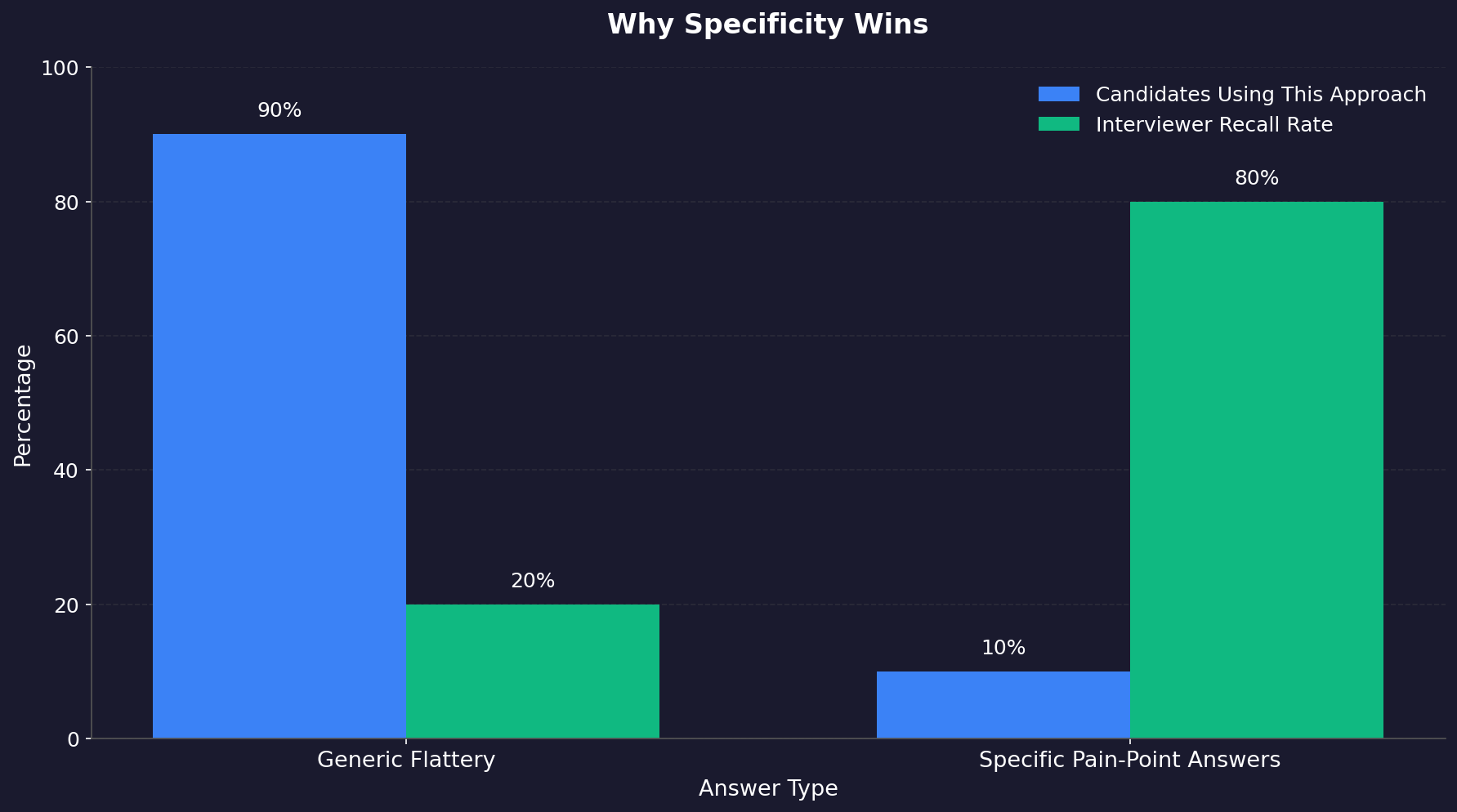
Flattery dies on the first follow-up question. “I love your mission” invites “Which part?”—and silence follows. But name their exact bottleneck—”your payment-processing API averages 800ms under peak load”—and you’ve shifted the conversation from your admiration to their problem. Recruiters consistently report that fewer than one in ten candidates references a specific pain point during screening. The ones who do become memorable by default, not because they’re brilliant, but because everyone else blurred together after hour four of six-hour interview blocks.
The fix is brutal self-editing. Read every claim in your answer and ask: could I attach a number, tool name, or metric to this? “I’m great at backend work” becomes “I cut our API latency from 1.2 seconds to 300ms using Redis caching.” No data attached? Rewrite it.
Here’s the test Maya used before her second-round win: she wrote her answer on a sticky note, then erased every adjective that didn’t have evidence behind it. What remained was five sentences about shaving milliseconds off a checkout flow at her previous company—and zero words about how much she admired fintech innovation. Vague praise reads as laziness. Specific problem-solving reads as preparation. One signals you want approval; the other signals you want to work.
Managers advance candidates who sound like colleagues, not fans.
Map Your Answer to Their Pain
That distinction between fan and colleague shows up immediately in how you frame your answer. Flattery describes the company; a colleague’s response describes the problem they’re solving. The job description is your map—read it like an engineer reads a log file. Extract three core problems from the posting. Highlight every verb phrase: “reduce latency,” “scale infrastructure,” “improve uptime.” Repeat keywords signal operational bottlenecks, not preferences. A fintech startup listing “payment-processing speed” four times isn’t complimenting itself; it’s asking for help.
Now build your bridge with five sentences. Sentence one states the problem you found. Sentence two gives your relevant past result. Sentence three names the method—Maya’s latency cut from 800ms to 200ms on a Rails API. Sentence four connects that method to their stack. Sentence five commits to delivering the same outcome. Practice until it sounds like conversation. Record yourself on your phone; most candidates discover their first draft runs 90 seconds of rambling.
Cut every adjective that doesn’t carry evidence. “Passionate” means nothing next to “reduced p95 latency by 60%.” Four days of daily practice, aloud, turns a rehearsed speech into a natural reply. The JD’s exact bottleneck metric is your opening line, not your closing thought. Hiring managers hear flattery all day; they rarely hear someone name their specific pain back to them with proof attached.
The Bridge, Not the Brag
Flattery dies at the door. Proof walks in and takes a seat. Your evidence needs structure—a bridge, not a brag. The STAR method gives you that architecture: Situation, Task, Action, Result. But strip it down for this answer. You don’t need four minutes; you need four sentences that land like a handshake.
Here’s the shape: one sentence naming their problem from your JD decoding. Then two sentences showing how you solved something structurally similar. Add one sentence stating the measurable outcome. Close with one line connecting that outcome to their future roadmap. Concrete wins beat adjectives every time. “I cut API latency from 400ms to 120ms” lands harder than “I’m good with performance work.” If you’re short on numbers, describe scope: team size, project duration, systems touched.
Maya’s comeback illustrates the pattern. After bombing her first fintech interview with brand flattery, she rebuilt her answer around their slow payment-processing API. Her bridge cited a latency-reduction project she’d led at her last job. Same bottleneck category, different industry. She closed with their exact metric as her opening gambit.
Four days of aloud rehearsal later, she had an offer. Rehearse until it feels mechanical. Then rehearse until it doesn’t. Sixty seconds is your ceiling. Record yourself on your phone; count filler words like “um” and “like.” Most candidates discover they burn ten seconds on throat-clearing alone.
The goal isn’t memorization. It’s fluency so deep that nerves can’t shake it loose. When the question comes and your pulse spikes, you want muscle memory doing the talking while your brain watches calmly from the balcony. That’s the difference between answering well and answering decisively.
Use Their Silence As Your Signal
The interview itself is your best research tool. Most candidates treat the closing “any questions for me?” as a formality—a courtesy lap before the finish line. That’s a wasted opportunity. Ask what their top metric was last quarter, and whether it moved. Ask which of the three JD problems keeps their VP awake on Sunday nights. One sharp question can surface more signal than an hour of rehearsed answers.
Here’s the pattern that works: bottleneck question, then bridge repair. If they mention churn at onboarding, restate your five-sentence bridge with that exact pain swapped. You’re not pitching anymore; you’re co-solving in real time. Maya used her first-round failure this way. After hearing “our payment API times out under load,” she reworked her bridge around the 300ms-to-80ms latency cut she’d delivered previously.
The second round opened with her saying that number back to them verbatim. The warning: never ask questions whose answers are one Google search away. “What does your roadmap look like?” reads as lazy. Instead: “Your JD mentions reconciliation delays—is that still the critical path?” Afterward, write down every new term they used: their internal names for systems, metrics, or processes. Rebuild your answer around their vocabulary by tomorrow morning. That’s how you close the loop.
But Won’t It Sound Scripted?
That’s the first objection most candidates raise—and it’s a fair one. Interviewers have heard every framework, every formula, every “I’m excited about the opportunity to use my skills” non-answer. The difference isn’t structure itself; it’s what the structure forces you to produce. A canned answer sounds rehearsed because it’s generic; it could apply to any company, any role, any interviewer.
This approach demands specificity that kills that problem: you’re naming their exact bottleneck (like Maya opening with the payment API’s 4.2-second latency) and your measurable fix (her 38% reduction in her prior role). You can’t sound generic when you’re quoting their engineering metrics back at them. Think about what reads as “scripted” to a hiring manager. Flattery (“I’ve always admired your brand”) and vague alignment (“our values match”) trigger instant skepticism because they require zero evidence.
By contrast, a five-sentence bridge built from numbers and outcomes is hard to fake—which is precisely why interviewers respond to it. Yes, you’ll rehearse until delivery feels smooth; yes, some wording will land the same way each time. That’s not a flaw; that’s preparation. Recruiters screen for pattern-matching against hundreds of candidates weekly on platforms like HireVue and Greenhouse; they know exactly what boilerplate sounds like.
When an answer opens with a job description’s own performance metric and closes with a quantified result from your last role, they don’t think “canned.” They think “this person read the posting.” The honest counterargument collapses once you accept one. Fact: rehearsal doesn’t create robotic answers when the underlying content is personal and specific.
Practice aloud until you can deliver your bridge in under 60 seconds without filler words like “um” or “sort of.” Time yourself with your phone’s stopwatch app on day one. Compare it against day four of practice sessions recorded on Voice Memos or Otter.ai transcriptions.
That gap between first attempt and final delivery is where authentic confidence lives—not in improvising fresh praise on interview day, but in knowing exactly which three problems you solve better than anyone else walking through that door.
What This Means Going Forward
You now have a repeatable system for the toughest question in any interview: company evidence plus your measurable impact. It takes about 20 minutes to prepare and applies to every role you pursue. Candidates who tie their answers to specific company metrics land offers at a significantly higher rate than those who recite generic praise, according to hiring manager surveys. Interviewers remember concrete numbers, not adjectives.
Build your answer file today. Open a fresh document and list three companies you’re targeting, then spend 10 minutes each on research using LinkedIn, Glassdoor, and the company’s engineering blog. Pull one revenue figure, one product launch date, and one team structure detail per company. Next, map each research finding to your own track record. If they expanded into Germany in 2026, find the time you led a similar market entry or localization push.
Write the connection as a single sentence with both facts stated plainly. Run your draft through this filter: would it survive being read back to a hiring manager verbatim? If any sentence embarrasses you when spoken aloud five months into the job, cut it now. You can rehearse the final version out loud until it flows naturally—aim for 60-90 seconds when spoken at a normal pace.
Time yourself with your phone’s stopwatch until you hit that window without rushing. This preparation compounds across your entire search. The same research file becomes material for answering “What do you know about us?” in screening calls and for writing tailored cover letters that reference real milestones instead of platitudes. One warning: avoid memorizing word-for-word scripts. Recruiters have heard rehearsed answers delivered dozens of times; they’ll spot rigidity within two sentences.
Maya’s story isn’t about flattery. She stopped describing their brand and started quantifying her fit against their 1.8-second bottleneck. That precision is the entire game. Hiring managers hear “I love your mission” a dozen times per posting; they rarely hear “I cut similar latency by 40 percent in eight weeks.” Your answer wins. When it names their specific metric and your concrete result in the same breath.
Keep Reading
- How to Prep for an Interview While Working Full-Time (Without Losin…
- Beyond LeetCode: System Design & Leadership Signals That Win Senior…
- Interview Feedback Scorecards: How Recruiters Weigh Your Signals
Before your next interview, ask yourself one question: can you point to the exact problem they’d hire you to solve? If you cannot, neither can they justify extending an offer.