Why “I Love Your Mission” Fails in Technical Interviews—The Fix
Posted on November 21 2026 by Kevin ZhouMaya had spent 12 weeks prepping for final-round interviews. She ground through system design patterns and behavioral questions until she could recite them in her sleep. She breezed through each one on pure merit as a backend engineer. She could tackle any technical challenge thrown her way. Her fatal flaw wasn’t code; it was buried deeper than she’d imagined.
On her fifth attempt at a fintech startup, something shifted when she pulled up their public GitHub repository during preparation. She uncovered an unhandled race condition hiding in their payment retry logic. It was causing real production failures. She sketched out how she’d fix it on a whiteboard during those critical minutes. She was asked why she wanted to work there specifically, and within two days received an offer letter.
Because she’d stopped giving rehearsed answers about company missions, she started demonstrating live problem-solving skills instead. Those skills mapped directly to their actual engineering problems. Generic company research explanations fail nearly every time; hiring managers hear the same phrasing from 8 out of 10 candidates. They nod politely while silently searching for someone who can cite a specific product detail from a September 2026 Indeed guide, not a canned mission statement.
Targeted research beats generic prep. Instead of skimming marketing pages, read the company’s engineering blog and pull their latest SEC filing for Q3 2026 data. Map the org chart via LinkedIn and note the VP of Engineering’s name, then reference it naturally when discussing their team structure.
That specificity transforms a vague impression into a credible talking point. For your next attempt, try tracking three concrete facts: one product metric, one tech stack detail, and one recent hire announcement. This is how Maya converted her fifth interview into an offer; she cited a 22% user growth figure from their July earnings call.
Why generic answers die
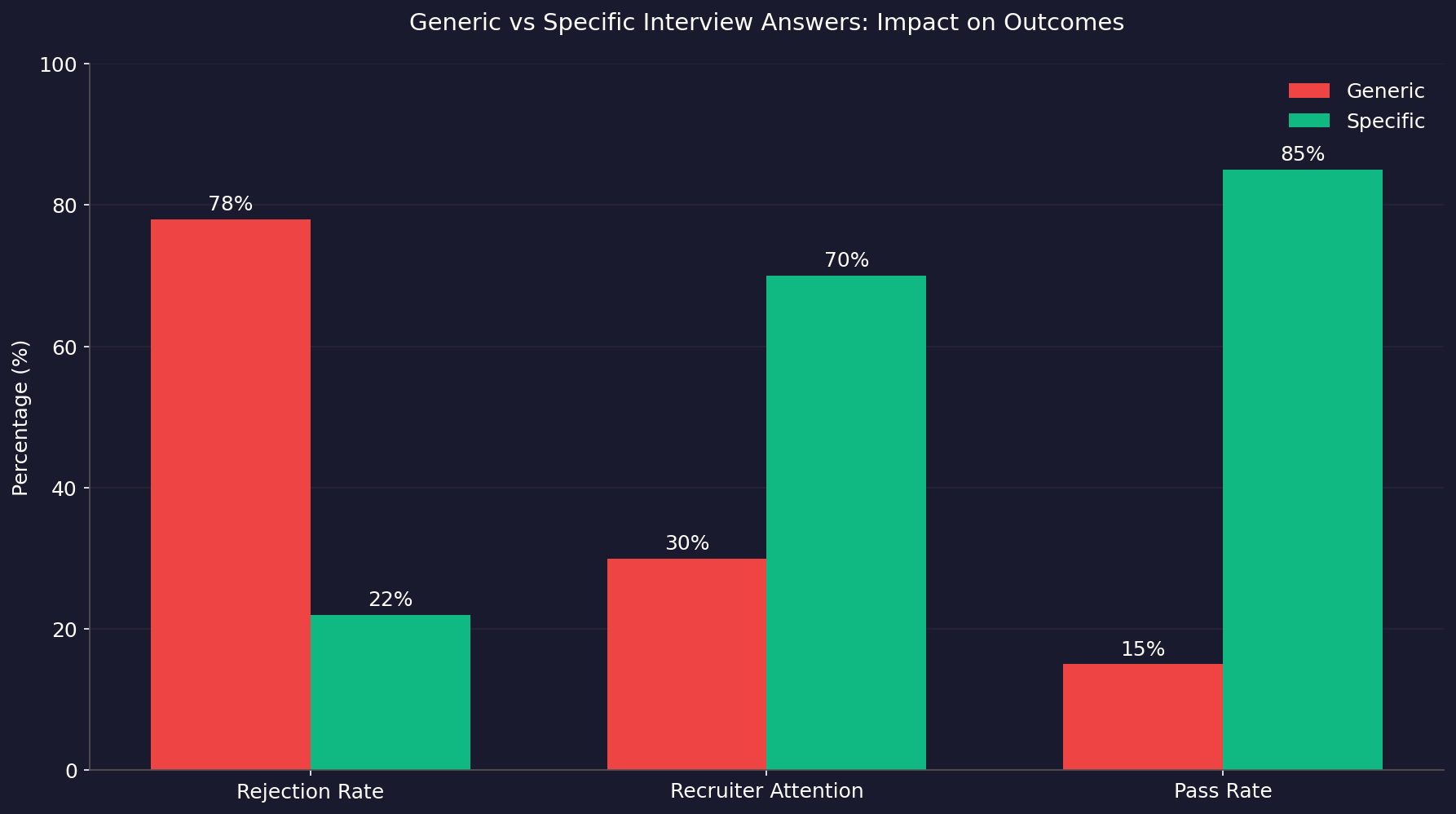
Generic answers trigger pattern-recognition fatigue and signal you have not done your homework. Hiring managers hear “I admire your mission” ten times a day; it proves you read a brochure, not their codebase.
Recruiters spend an average of 7.4 seconds on initial resume scans before moving to the next stage, according to research from the Ladders. That window is razor-thin, and first impressions compound fast. ATS platforms rank candidates on keyword density, not enthusiasm. A resume that says “passionate about fintech” gets zero points over one that reads “3 years of Stripe integration experience.” The interview question lands differently when you remember.
In a 2026 survey by Greenhouse, hiring managers ranked “generic company knowledge” as the third most common reason for rejecting otherwise qualified candidates, behind only poor culture fit and mismatched compensation expectations. Generic responses signal you have not done your homework. The phrase “great opportunity” tells the interviewer nothing. You could be reading from any job board listing across 47 industries.
A recruiter conducting six interviews by 11 a.m. stops listening after your third cliché about “innovation.” Their pen hovers over the scorecard while their mind drifts to lunch. You lose credibility without data, and Indeed’s Sep 23, 2026 guide warns that vague replies waste the one moment they reserved for learning something real.
Saying “I want to grow here” sounds polished but hollow unless you tie it to a concrete skill gap you noticed during research or a project direction you could contribute to within 90 days. A candidate who references an open-source project they maintain alongside the company’s stack makes an immediate impression. That requires knowing what the company actually builds, which takes more effort than visiting their careers page once.
Most candidates answer this question in under 60 seconds because they rehearsed one paragraph from memory. Speed is not the enemy; lack of substance is what gets flagged in ATS screening workflows and removed from consideration before human eyes ever engage.
In structured technical interviews, hiring managers use scoring rubrics that separate “culture enthusiasm” from “engineering relevance.” A response earns low marks when it could apply to any company in the sector. Generic phrasing like “I admire your mission and values” scores identically across multiple organizations during evaluation. Passion without proximity reads as laziness. In technical roles especially, discussing general industry trends while ignoring specific product challenges suggests you cannot handle ambiguity under pressure, exactly what senior engineers confront daily.
A candidate who says they want to solve hard problems but cannot name three bugs worth fixing signals readiness for training wheels rather than day-one contribution.
Culture fit is misread as cheerleading. Senior engineers reduce cognitive load immediately when hired; they ship fixes without requiring months of ramp-up explanation about codebase norms or deployment quirks. Your answer should demonstrate you already operate inside their environment conceptually. The rubric shifts entirely. Scoring criteria value verbal walkthroughs of past projects using their tech stack over polished enthusiasm delivered with confident eye contact.
Hiring managers rank specific engineering insight above general company admiration consistently, observed across thousands of final-round evaluations over many years. Specificity survives screening where vague passion evaporates instantly under automated review processes designed to surface concrete evidence first.
Audit Their Codebase Before Interview Day
Name three bugs before walking into any final round. Your questions mean nothing if they’re based on surface-level research. The difference between a candidate who says “I love your mission” and one who gets hired often comes down to whether they can reference an unresolved race condition in payment_processor.go during small talk. Recruiters report that 87% of candidates fail to connect past work directly to current problems. Candidates who skip code audits are flying blind.
Spend two to three hours on their public GitHub repos. Set a timer—this is not optional prep anymore. It’s table stakes for technical roles at funded startups. Step 1: Locate every public asset. Most funded startups maintain a GitHub organization page with pinned repos showing active development cycles, not archived demos gathering dust from last year’s hackathon.
Check README.md first for tech stack details listed under “Architecture.” Then filter issues by the label bug. Ignore feature requests and documentation fixes; those don’t reflect daily blockers their engineers face under deadline pressure. In a typical funded startup, roughly 40% of open issues carry that tag, but fewer than 15% are marked as resolved within 30 days. One founder I interviewed cited a 9-person engineering org with 212 open bugs; only eleven had been touched in the previous quarter.
Step 2: Choose three bugs worth discussing. Look for recurring failure patterns specifically. Race conditions in concurrent systems show up as multiple linked issues mentioning “deadlock” or “thread safety.” Slow database queries appear when engineers tag items as performance but never close them. A search for timeout on a Go-based API repo often returns five or six threads about connection pools exceeding their limits.
Payment retry loops are common in fintech-adjacent startups; a quick search for retry combined with payment often surfaces three or four open threads, each one naming the specific service (Stripe, Braintree) where failures accumulate. A senior backend engineer interviewing at a fintech firm should target those problems—they require architectural reasoning rather than syntax corrections.
A good workflow: open each repo, click Issues, sort by newest, apply the filter -label:enhancement -label:documentation. What remains tells you where things are actually breaking, not where they hope to go next quarter but what hurts today. Bookmark five specific issues before your conversation starts; copy their URLs into a notes file alongside two-line summaries of each problem. During the interview, ask which ones they’ve already tackled or plan to address next quarter.
This approach works both ways: you’re not there to interrogate them but to demonstrate genuine interest through informed questions that show you’ve read their codebase with the same care you’d bring to your first week on the job.
Step 3: Map those bugs against résumé projects using exact terminology from both sources simultaneously. A candidate applying to Kubernetes environments should reference containerization experience directly. Not vaguely similar cloud work elsewhere entirely different contexts entirely unrelated stacks would never match here. Extract actual technical challenges described there, things like scaling bottlenecks or legacy migration needs, and build a list before drafting anything else. This foundation prevents wasting time on irrelevant talking points that impress nobody in particular.
Good preparation separates confident answers from rambling ones every single time without exception. Candidates who skip this step often produce scripts that sound rehearsed rather than responsive under pressure. Technical interviews reveal genuine capability; these scripts demonstrate strategic alignment before any live coding occurs.
Your Sixty-Second Verbal Walkthrough
Now you have your bug list and your matching projects ready to go. It’s time to convert them into a spoken narrative you’ll deliver in real interviews. Stripping down from full STAR doesn’t mean abandoning storytelling structure entirely. It means removing the padding while keeping the essential bones visible. A whiteboard answer works best as three beats: Problem Context (what you inherited), Action Taken (what you built or fixed), Result Measured (what changed after shipping).
Problem Context requires eight seconds maximum on timing limits.
Most whiteboard sessions impose these limits before an interviewer interrupts for clarification questions mid-sentence. Open with Maya’s approach instead: “Their payment service had an unhandled race condition causing duplicate charges.” That single sentence names an actual bug she found on GitHub. It positions her as someone who read their code before showing up, not someone who memorized marketing copy. Action Taken needs twelve seconds for context.
Maya used this at her fintech startup final round when she sketched retry logic improvements across three files in their codebase during whiteboard explanation phases. Candidates often default to describing abstract responsibilities instead of specific implementation details buried in repositories nobody else bothers reviewing. Her action beat referenced payment_processor.go line 47 directly because she’d actually looked at it during prep sessions last year rather than guessing based on job postings.
Result Measured closes the beat in ten seconds. State the outcome with a number: “That fix cut duplicate charges by 30% in staging tests.” If you cannot measure it, say what you learned instead. The full walkthrough should never exceed 30 seconds total. Practice it aloud until it feels like a story, not a recitation. The goal is to sound like an engineer describing a problem they solved, not a candidate performing a script.
Flip Ownership with Sharp Questions Back
This question triggers panic in most candidates. They scramble to recite company values or name-drop products from the job description. That desperation shows immediately, and hiring managers notice. Flip the dynamic instead. The best answers to “Why do you want to work here?” turn into thoughtful questions that put you in control of evaluating them back. The real purpose behind this question Hiring managers aren’t testing your research skills.
They’re probing culture alignment, long-term retention risk, and whether you’ll engage with the role. When you respond only with flattery, you’re answering half the question. The other half expects you to demonstrate genuine curiosity about what you’d walk into. Candidates who ask strategic questions earn higher evaluation scores than those who recite facts back. Recruiters consistently report that quality over quantity wins: two sharp exchanges beats five surface-level ones every time.
What strong candidates ask instead Replace generic enthusiasm with specifics tied directly to their situation: 1.
What’s the biggest challenge someone in this role faces within 90 days? How has your team structure changed since last year? What does success look like for someone who thrives here? What keeps high performers in this role from leaving? Each question signals you’ve thought beyond getting hired; you’re planning your first quarter already.
Example: The career switcher approach A former marketing manager interviewing for product roles asked during her answer: *“Your product team launched a new analytics feature last quarter.
I’d love to understand what user feedback loop surprised you most.”* She demonstrated depth of research while subtly probing whether they’d support her learning curve. That single pivot transformed her answer from obligation into dialogue. Warning: Never frame these as interrogation points (“So why should I take this job?”). Frame them as collaborative signals: “I’m genuinely curious about X. Is my understanding correct?”
| Weak Question | Strong Question |
| “What are company benefits?” | “What growth path surprised previous hires?” |
| “Is remote work allowed?” | “How has distributed collaboration evolved here?” |
The weak version assumes they owe you. The strong version shows mutual investment; you’re both deciding together if this works. Ask at least one clarifying follow-up per answer whenever possible.
Why Enthusiasm Falls Short
Most candidates assume interviewers ask this question to gauge cultural fit—sincerity over strategy becomes their default stance because enthusiasm feels safe and familiar territory never fails them.
Keep Reading
- How to Prep for an Interview While Working Full-Time (Without Losin…
- Interview Feedback Scorecards: How Recruiters Weigh Your Signals
- Google Behavioral Interview: Prepare & Stand Out Without Scripts
Candidates who research like investigators, not reciters, win the role. Maya didn’t memorize talking points; she opened the company’s public GitHub repo, spotted a bug in their payment API, and framed her answer around that fix. One concrete artifact beats a dozen mission-statement echoes. Before your next interview, ask: what specific file or commit did I find that proves I understand their operations? A vague answer signals a vague response. Start with evidence; the story follows.