Why Do You Want to Work Here? 12+ Best Answers (2026) That Win Offers
Posted on November 22 2026 by Kevin ZhouMaya’s fourth rejection stung the worst. The mid-level backend engineer had delivered the same polished “I love your culture” line to four different startups in Q1. Each panel nodded politely before showing her the door. She was technically strong; her GitHub history proved it. But her answers never touched the actual engineering problems those companies were wrestling.
So she changed tactics. Maya pulled up InterviewZen’s algorithmic question bank and dissected her target startup’s public tech debt. She walked into interview number five with a precise fix proposal for a known database sharding flaw. She rehearsed against a simulated panel, hit her confidence threshold, and converted that meeting into a signed offer. Her summary to our team: “Specificity was my only credential.” That word is the entire argument of .
Generic passion statements are dead in 2026; they read as lazy to hiring managers who have heard them a thousand times. Candidates who anchor their response to verifiable platform specifics convert interviews into offers more reliably than those who wing it on enthusiasm alone. The gap between Maya’s first four failures and her fifth success wasn’t talent or luck.
It was preparation built on concrete research: reading the company’s roadmap, mapping her skills to their stated priorities, and practicing until the answer felt surgical rather than scripted. You want that edge too. The next section breaks down exactly how to build that three-part answer matrix before your next interview.
The Specificity Crisis
That edge is disappearing fast. Hiring managers now hear the same polished phrases on repeat.
They’ve built an immunity to “I love your culture” and “I’m passionate about your mission.” These answers used to work because they signaled enthusiasm. Now they signal that you didn’t bother to look past the careers page. Maya learned this the hard way. A mid-level backend engineer with solid Python and AWS experience, she burned through four interviews in Q1.
Each one featured variations on the same theme: genuine admiration for each company’s brand, zero evidence she understood their technical reality. Every rejection email used different words but said the same thing: we found candidates whose technical vision aligned more closely with our roadmap. She wasn’t unqualified. The shift is structural, not personal. AI-assisted screening tools now flag generic responses as low-effort signals.
They push them down the ranking before a human recruiter ever reads them. One hiring manager put it bluntly: “If your answer could apply to any company on the planet, I assume you’d rather be somewhere else.” That sentiment has quietly become industry standard across engineering teams at late-stage startups. Interviewers now expect candidates to treat their company like a codebase worth studying.
Not a logo worth praising. When Maya finally opened her fifth interview by referencing her target startup’s public tech debt issues from their last engineering blog post, she watched the panel’s posture shift in real time. She got that offer and later told our team: “Specificity was my only credential.” You don’t need Maya’s quarter of failures to learn this lesson. You need a repeatable method for converting research into answers that sound like you’ve already worked there.
Which is exactly what the three-part answer matrix provides in section two.
Mining Their Engineering Pain
Confidence without evidence is just volume. The fastest way to build real specificity is to stop reading the company’s marketing page and start reading their code. Start with the public changelog. Every SaaS company ships a changelog, and those entries reveal what they’re actively fixing, not what they claim to value. If you see three consecutive releases patching authentication flows, that’s your opening. You can walk in with a concrete observation about their session-handling logic without ever guessing.
The workflow takes ten minutes, not an hour. Open their GitHub org page, filter by recently updated repos, and skim commit messages from the last two weeks. Job descriptions give you the stack; commit messages give you the friction points. A candidate who says “I noticed you migrated from CircleCI to GitHub Actions in Q3” has already outperformed every candidate who rehearsed a generic answer.
Pair this with a quick pass through their open issues tagged “tech debt” or “good first issue.” These aren’t busywork—they’re a map of what the team knows is broken.
One hiring manager told me she extended an offer largely because a candidate referenced a three-month-old issue about slow database migrations that her own engineers had stopped noticing. You’re not researching to flatter them. You’re researching to diagnose. That distinction matters because interviewers can smell manufactured enthusiasm from the first sentence. But they cannot dismiss a specific observation about their infrastructure—it’s verifiable, it’s current, and it proves you did homework that most candidates skip entirely.
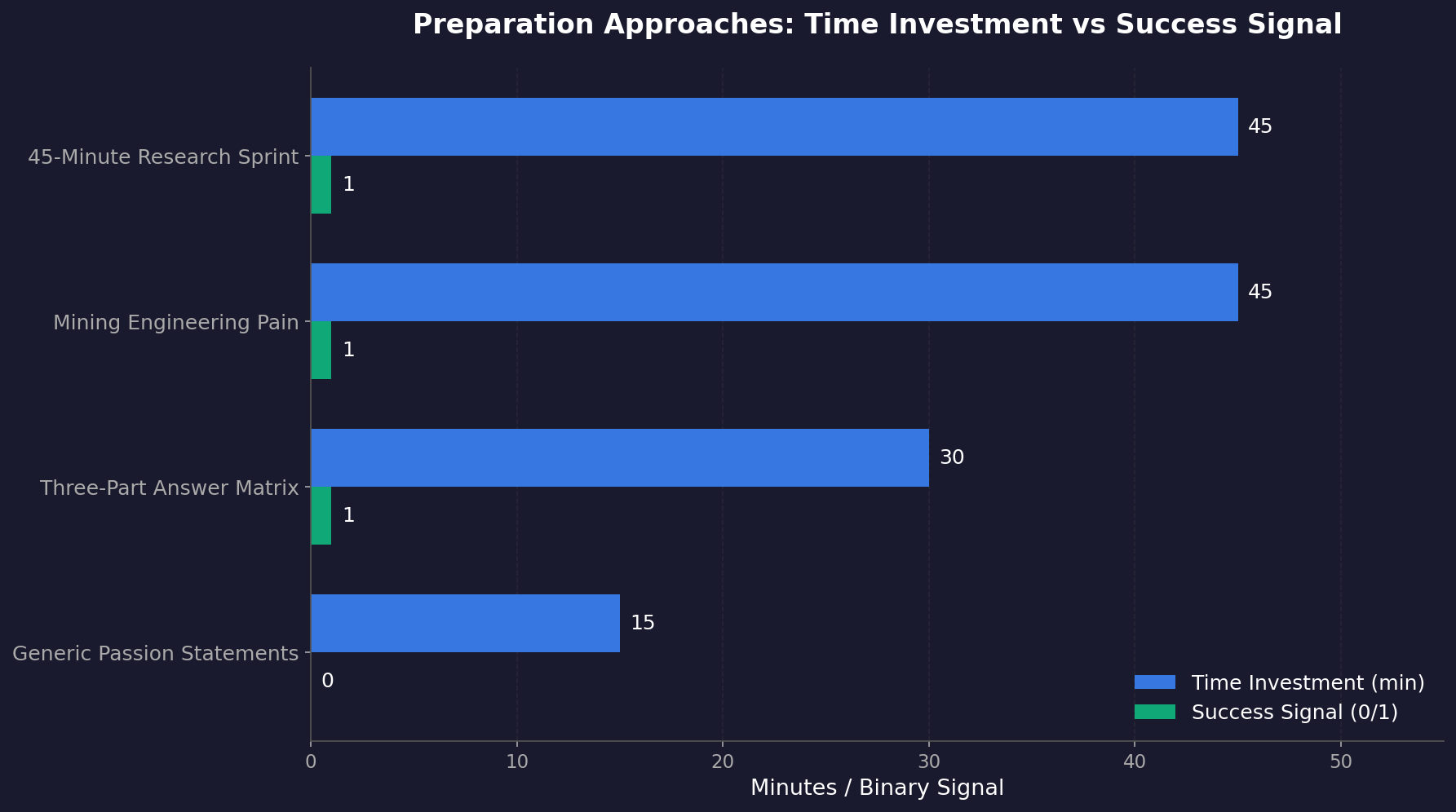
To structure your findings, collapse every “why us” question into three verifiable layers: product, process, and people. You prepare one concrete claim per layer, then practice until each claim survives follow-up probing. Layer one is product. Open the company’s public GitHub repositories or changelog and find one technical decision you genuinely understand. If they migrated from PostgreSQL to CockroachDB last year, explain why that matters for their multi-region latency targets. Don’t just name the database.
Layer two is process. Study how the team ships work by reading their engineering blog or public RFC documents. Mention their structured design-review template by name, then connect it to a past project where you benefited from similar ceremony. Layer three is people. Scan LinkedIn for the hiring manager’s recent conference talks or open-source contributions. “I saw your talk on idempotent API design at QCon” outperforms any generic praise of culture.
Build your matrix in a single sitting. Set a 45-minute timer, open three browser tabs (GitHub, engineering blog, LinkedIn), and force yourself to write one sentence per layer before the timer ends. Now rehearse against a mock panel until you can deliver all three layers without notes in under 90 seconds. Target an 85% confidence threshold—not perfection, but fluency with your own evidence. When specificity carries your answer, enthusiasm becomes optional.
The 45-Minute Research Sprint
The discipline is extracting three verifiable facts in 45 minutes, not drowning in documentation. Most candidates who fail this sprint spent their time wrong—they opened the wrong tabs first.
The sequence that works: Open their engineering blog in one tab. Pull up their GitHub org in a second. Load LinkedIn for the hiring manager in a third. Read their last two posts about technical decisions, not their mission statement. If they wrote about migrating Postgres to CockroachDB for multi-region consistency, that’s your entry point—not their S3 backup schedule or their choice of Skeleton CSS.
One candidate spent three hours building a spreadsheet of every commit from their target startup’s main repo. She walked into the interview with a folder of notes and zero usable observations. Her answer still sounded like every other candidate. The hiring manager asked one follow-up about their S3 lifecycle policies, and she had nothing.
The fix is narrower reading, not deeper reading. Search Hacker News threads for their domain name—founders answer stack questions there that never make the blog. Filter GitHub repos by “good first issue” and “tech debt” tags, not commit volume. A backend engineer who finds a startup’s changelog entry about slow database queries has a response worth rehearsing. One who finds their S3 bucket naming convention has a detail worth mentioning under 90 seconds.
Warning: skip any pain point they’ve already solved. Bringing up a fixed issue reads as dated homework, not insight. Check the release date before you build your response around it. The math is 45 minutes of manual research when you open the right sources first. Automated tools can compress that to ten, but the core discipline—identifying current infrastructure facts worth mentioning—remains identical regardless of method.
Rehearsal That Survives Contact
Reciting prepared answers is a gamble with poor odds. One interruption crumbles your rhythm, and memorized lines dissolve into awkward silence. The fix is adversarial rehearsal. Build a mock panel of two or three peers who rotate hostile variations of the same question. “Why us?” becomes “Why us over the offer you have from our competitor?” Your job isn’t to deliver a speech—it’s to defend a position under fire.
Score each run against three weighted criteria: clarity (30%), alignment with the company’s roadmap (40%), and conciseness (30%). Clear a consistent benchmark threshold—not a fixed number of rehearsals—before you trust your preparation. Clarity means no jargon without explanation. Alignment demands you cite specific product decisions or public technical debt discussions from the last two quarters.
Conciseness caps your answer at ninety seconds, forcing precision under pressure. Reviewing playback reveals verbal tics. Filler words like “um” and “basically” cluster where your confidence drops—which is also where interviewers probe hardest. One warning: avoid rehearsing with people who already know your background. Familiarity breeds assumptions that mask weak explanations.
Strangers ask the obvious questions you’ve stopped asking yourself, and those are exactly the gaps an interviewer will exploit. The benchmark matters more than repetition. Unfocused run-throughs reinforce bad habits; scored sessions reshape how you think on your feet. Maya, after four rejected attempts, hit her stride only when she tracked her scores instead of counting her hours. Specificity in preparation produces specificity in delivery.
Keep Reading
- How to Prep for an Interview While Working Full-Time (Without Losin…
- Interview Feedback Scorecards: How Recruiters Weigh Your Signals
- Google Behavioral Interview: Prepare & Stand Out Without Scripts
When your answer survives three rounds of adversarial probing without cracking, walking into the real room feels less like performing and more like confirming what you’ve already proven elsewhere.