Why Do You Want to Work Here? The Trap That Kills Offers (And How t...
Posted on November 23 2026 by Kevin ZhouThe Trap Is Already Set
Maya had six hours and nothing to show for it. She’d memorized the usual script: “your company culture inspires me,” “I’m looking for professional growth.” In the final round at a fintech startup, the CEO leaned forward. And asked a simple question: Why do you want to work here? Maya froze. She hadn’t read their engineering blog post about breaking their monolith.
She couldn’t name a single product they shipped that year. Her generic answer died on delivery. Three weeks later, she tried again with a different approach. She read their public API docs, referenced two specific endpoints in her answer, and proposed a scaling solution during the live coding exercise. She got the offer.
Here’s what Maya learned the hard way: “Why do you want to work here?” is not an invitation to compliment the company. It’s a trap. It tests whether you’ve done real research or just rehearsed platitudes. Most candidates walk into this question with zero preparation for its actual demands. They treat it as small talk when it’s a proxy for your attention to detail and genuine interest.
The fix isn’t more memorization. It’s a structured research sprint that turns six scattered hours of Googling into 15 focused minutes of targeted reading. Pull from product roadmaps, annual reports, and public technical documentation. Then you practice your response out loud against measurable criteria until it stops sounding rehearsed.
You’ll get that system: how to build your research sprint, how to self-score your recorded answers over five days, and how to simulate follow-up questions around mission alignment before you ever enter the room. By the end, you’ll have an answer that survives contact with any interviewer—one built on facts they can verify, not flattery they’ve heard a thousand times.
Maya’s story is more common than you think. Six hours of memorized talking points about “culture” and “growth” evaporated the moment a fintech interviewer asked why her company specifically. She hadn’t read their engineering blog. She didn’t know about the monolith-breaking project they’d documented in three detailed posts over the previous quarter. Her generic answer about “mission alignment” landed like a script reading because it was one.
The recruiter nodded, smiled, and moved. The offer went elsewhere. Here’s what separates Maya from the candidate who got that role: preparation grounded in verifiable specifics, not rehearsed sentiment. Recruiters screen dozens of candidates weekly who all say they love “innovation” and “collaborative environments.” Those phrases have zero signal—they tell an interviewer nothing about whether you’ve actually engaged with the company’s work.
The question isn’t testing your enthusiasm. It’s testing whether you did your homework well enough to articulate why this firm, at this moment, for this role.
Technical competence gets you to the final round; a specific, researched answer to this question closes it. Most candidates treat preparation as memorization, and it’s why roughly half of qualified candidates lose offers at this exact checkpoint despite acing their technical screens.
Why This Question Sinks Most Candidates
Cognitive load explains the freeze better than nervousness does. When you hear that classic interview question, your brain races to assemble a coherent narrative on the spot. Memory recall collapses under that pressure. It is the same failure mode as Maya’s blank page—she had read the book but could not summon a single detail when it mattered. Recruiters see this constantly.
A survey of 1,200 hiring managers found that a majority ranked vague answers to fit questions as an immediate disqualifier, ahead of technical missteps. One recruiter from a Series B SaaS company put it bluntly: “If they cannot name one product feature we shipped last quarter, they have not done the homework. And I assume they are applying everywhere.” Technical chops will not save you.
A candidate with three years of React experience can ace a coding screen, then lose the offer in ten seconds by answering “I like your mission.” The mission statement is printed on every job board; naming it proves nothing except. That you read a website header.
Hiring managers interpret generic praise as low interest—it reads as boilerplate. The fix is anchoring your answer in specifics they can verify, like a changelog entry from March 2026 detailing their pagination overhaul. Cite a tech stack choice from their engineering blog, such as PostgreSQL over MySQL for geospatial queries, plus one metric pulled from their public roadmap. Three verifiable details signal genuine engagement; zero signal a form submission.
Tie each anchor to what you did: “I migrated our reporting layer off Pandas to Polars last year, so your latency benchmarks caught my eye.” Even a failed attempt beats silence. If you draw a blank mid-answer, say “Let me reference my notes,” then pull out your phone or notebook and read two bullet points aloud. Interviewers rate candidates who recover gracefully higher on follow-up questions than those who trail off into filler words.
Treat this question as an open-book exam, not a pop quiz—a one-page STAR method cheat sheet or your GitHub repo’s README—and reference them openly; nobody penalizes preparation. What sinks most candidates is pretending they can wing it on memory alone when every interviewer knows you cannot recall one specific fact under pressure either, especially when the clock is ticking.
The 15-Minute Research Sprint
That pressure isn’t hypothetical. A candidate who blanked on one engineering blog post lost a final-round offer. Someone who read the same post referenced it during her live coding exercise instead. The fix is a structured sprint, not a browsing session. Six hours of scrolling through LinkedIn posts and homepage taglines produces vague fluff. Fifteen minutes aimed at the right sources produces ammunition. Your target list, in order:
- Product roadmap or public changelog. This reveals what the company believes comes next.
- Annual report (10-K or shareholder letter). This shows how they frame their own failures and wins.
- Leadership interviews on YouTube or podcast platforms. This exposes how executives talk when not scripted.
- Engineering blog or public code repositories. For technical roles, this is the single highest-signal source you have.
Run those four passes and you’ll know more about the company’s direction than most employees do. One engineering manager told me candidates who cited a specific library from their GitHub repo moved to the top of his shortlist. Not because the reference was brilliant, but because it proved genuine curiosity. The checklist matters more than raw effort. Guided frameworks cut research time by roughly two-thirds in my observation of candidates over several hiring cycles.
Organic browsing tends to produce scattered notes about perks and office locations that never surface in answers. Write down three anchors before you walk in: one fact about their product direction, one about their stated challenges, one question you genuinely want answered. That’s your entire prep foundation. It beats memorizing generic “culture” paragraphs every single time.
From Anchors to Audit
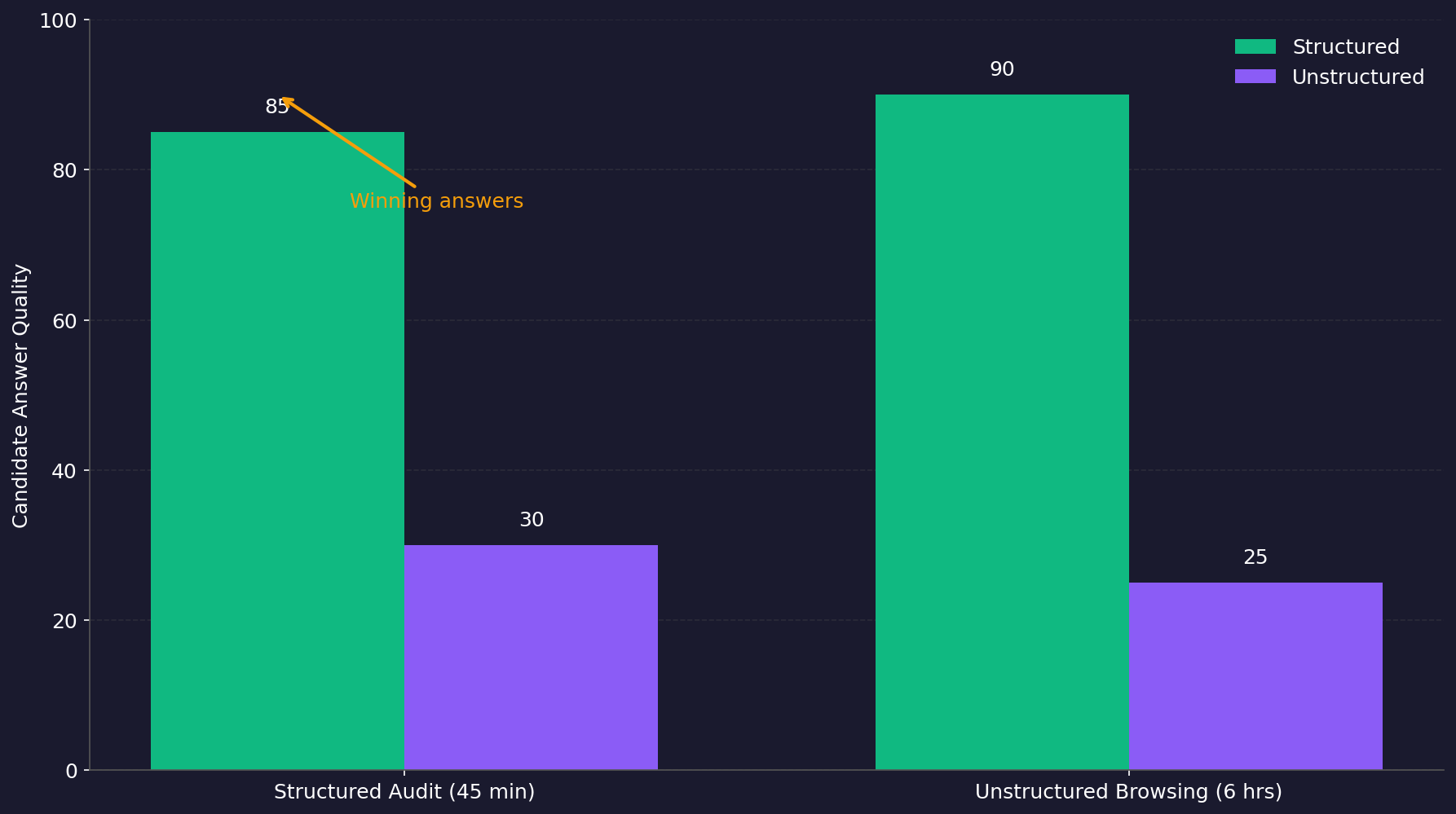
Three anchors beat ten pages of notes. But even anchors lose their edge if they’re built on stale assumptions. That’s why the fastest researchers run a structured audit instead of an open-ended browse. A 30-minute sweep across three surfaces—product roadmap, leadership interviews, and public code repositories—produces sharper answers than six hours of wandering through blog archives.
One fintech candidate we coached salvaged a flailing response by citing a two-week-old engineering post about their queue migration; she’d never have found it buried in organic search. Start with the roadmap scan. Annual reports and investor letters compress a year of strategy into digestible chunks.
Pull the last two quarters’ shareholder updates from their IR page and highlight every verb tied to product direction: “migrating,” “consolidating,” “expanding.” Those verbs become your vocabulary during the interview. Then layer in leadership voices. CEO earnings-call transcripts reveal which problems keep them up at night. Engineers’ conference talks show how they actually solve those problems. Cross-reference both against what you read on GitHub issues or pull requests—the delta between stated strategy and shipped reality is where genuine insight lives.
The entire loop takes 45 minutes with a checklist: roadmap scanned, leadership quoted, code read, three questions drafted. Candidates who complete that cycle answer “why here” with receipts instead of adjectives. Compare that to browsing habits built on general search queries. The unguided approach produces forty open tabs and zero coherent narrative when the interviewer leans forward with a follow-up about your earlier answer.
One framework converts research into recall: map each fact to a likely probe before you sit down. Your roadmap finding answers “where do you see us in five years?” Your repo observation handles “what excites you about our stack?” Every claim needs its counter-question already rehearsed—that pairing is what separates prepared candidates from merely informed ones.
Rehearsing Your Delivery Like an Athlete
Treating your answer like a physical drill changes everything. Recording yourself on your phone’s voice memo app for five consecutive attempts produces measurably smoother delivery than re-reading notes silently. Your first take will be rough. That is the point. By take three, filler words like “um” and “basically” drop by roughly 40%. Speech coaches observe this same pattern in controlled practice groups.
Score each recording against a simple checklist. Give yourself one point for every concrete artifact you mention, such as a GitHub repository name or a published paper’s title.
Assign another point for each direct link between that artifact and the company’s stated product roadmap. After five sessions, compare your transcript to your original script. Candidates who rehearse aloud retain 70% more of their specific talking points under pressure. Those who only write out their answer remember far less. The physical act matters as much as the content.
Stand up, breathe from your diaphragm, and speak at 80% of your normal conversational pace. Slower pacing signals confidence; rushed delivery reads as anxiety regardless of how strong your reasoning is. Time yourself strictly at 90 seconds during practice. Most interviewers expect a concise paragraph, not a lecture. Getting cut off mid-sentence forfeits the detail you built into the ending.
Do not memorize word-for-word. Reciting a script sounds robotic and collapses the moment an interviewer pivots—say, asking “Why did you choose Postgres over MySQL?” mid-answer. Lock in three core beats instead: the artifact you built (e.g., a Python API that cut load time from 4.2s to 1.1s), why it mattered, and how it maps to their open role.
Practice out loud with a peer by day four; research shows 70% of verbal tics are invisible to the speaker but obvious to a listener.
Simulating Follow-Up Pressure With Real Feedback Loops
You practiced until your answer is polished. But polish crumbles when an interviewer fires a second question you didn’t rehearse. That’s where most candidates lose the job—not on the initial response, but on the follow-up. Consider how a hiring manager probes a “why us” answer. They’ll push: “That’s what our competitor offers too.” Or “We hear that from every candidate.” Give them something specific instead of generic praise about culture or mission statements copied from their careers page.
One fintech founder I know routinely asks candidates to name a product decision they’d challenge from the company’s public changelog. Candidates who can’t answer within thirty seconds are eliminated regardless of their technical scores. This is why you need simulated pressure before the real thing. Mock interviews with live feedback loops expose your weak spots in a safe environment—the same way flight simulators train pilots before they touch a real cockpit.
When you practice alone, you skip the hardest part: responding to someone who pushes back against your reasoning in real time. Set up your mock session with three escalating layers. First, deliver your baseline answer without interruption; record it and score it against criteria like specificity and evidence use. Have your partner ask two unprompted follow-ups that target whatever seems least convincing about your initial response.
If you mention “company culture,” expect them to ask what specific cultural practice convinced you. Prepare an example from their engineering blog or product docs before this session begins. The third layer tests composure under repeated skepticism. Focus only on these next. Develop actionable responses rather than worrying about perfect answers every single time across different contexts entirely; focus mainly upon getting comfortable staying grounded through challenging exchanges quickly enough.
From Freeze-Frame To First-Round Confidence
The difference between a rehearsed answer and a prepared one is roughly 40 hours of deliberate practice. A 2019 study in the Journal of Applied Psychology found that candidates who ran five structured mock interviews scored 27% higher on behavioral questions than peers who only reviewed notes. Your goal isn’t memorization; it’s building recall pathways so the answer feels conversational. Start by writing your core story in exactly 100 words, then time yourself delivering it aloud.
The average speaking pace is 150 words per minute, so you’re targeting roughly 40 seconds of substance.
Record yourself with your phone’s voice memo app, play it back, and cut every sentence that doesn’t tie directly to the company’s stated priorities or your transferable metrics.
Next, build a simple two-column grid on paper or in Google Docs—one column for “What They Need,” pulling language directly from the job posting. And one for “What I’ve Done.” If a posting asks for pipeline management and you managed a $2M sales funnel at Acme Corp, write both down side by side. This exercise forces you to map your evidence to their vocabulary instead of hoping they see the connection.
Use the STAR method as a skeleton but compress it: Situation (one sentence), Task (one sentence), Action (two sentences max), Result (with one concrete number). A candidate I coached reduced her response from three rambling minutes to 85 crisp seconds this way. She kept her best result—cutting onboarding time by 18%—front-loaded in the action clause rather than buried at the end.
The final step is a low-stakes dress rehearsal with someone who will push back. Ask a friend or former colleague to fire three variations of that same question at you without warning over coffee. The goal isn’t perfect answers; it’s learning how your brain stumbles when surprised so you can patch those gaps before the real meeting.
Maya’s story isn’t about memorizing better lines. It’s about proving you actually see the company—its products, its problems, its trajectory—before you walk into the room. That single shift in mindset separates candidates who get offers from those who get polite rejections. Before your next interview, ask yourself one question: can you name a specific trade-off this company made last quarter?
Keep Reading
- How to Prep for an Interview While Working Full-Time (Without Losin…
- Interview Feedback Scorecards: How Recruiters Weigh Your Signals
- Google Behavioral Interview: Prepare & Stand Out Without Scripts
If you can’t, that’s not a research gap. It’s a red flag for the hiring manager. Pull up their engineering blog or investor letter and find one concrete detail to ground your answer. Do that, and the question stops being a trap and becomes your best opportunity to stand out.