Why Do You Want to Work Here? The 2026 Data-Backed Answer
Posted on November 24 2026 by Kevin ZhouWhy Every Stock Answer Fails Now
“I love your mission.” A 2026 survey of 1,200 recruiters found this phrase ranked dead last in signal value—behind even “I need a job.” Hiring managers now treat it as scripted. Default. Not a data point.
The problem is structural. Modern hiring pipelines score candidates against 8–10 specific competencies per role. A mission statement tells the panel nothing about your ability to ship code, run discovery calls, or handle an angry stakeholder at 4:55 PM. Common stock phrases have flipped from neutral to negative.
When hiring managers hear “I want to grow with you,” 63% flag it as a red flag for lack of preparation. That’s according to a 2026 Greenhouse analysis of 40,000 interview transcripts. The phrase signals you memorized a blog post, not that you researched the role. Compare two answers to the same question. Weak: “Your company values innovation and culture fit.” Strong: “In April, your team shipped the mobile onboarding update that cut drop-off by 18%.
I’d like to do similar work on the backend metrics pipeline.” The gap isn’t enthusiasm. Recruiters don’t need more compliments; they need proof you understand their operational reality.
Watch out for reverse stock answers too. Saying “I want to learn new skills” triggers the same dismissal rate as mission-speak. One LHH report from March showed candidates who cited personal development goals scored 31% lower on culture-fit ratings than peers who named specific projects.
A strong answer survives screening only if it carries three specifics: one named project or metric from their history, one skill that matches their current bottleneck, and one reason tied to this role’s daily work. Not the abstract brand. Generic replies get filed away within 30 seconds, and they never move the scorecard.
The Job Description Is a Complaint List
Generic answers die quietly. They don’t get challenged or corrected. They simply get scored lower on a rubric you never see. A 2026 survey of 750 hiring managers found that 68% rank role-specific problem-solving above cultural alignment when evaluating early-stage candidates. The same study flagged “I love your mission” as one of the top three phrases that triggered immediate skepticism. That phrase tells them nothing about whether you can reduce their ticket backlog or cut their cloud spend.
Consider how structured interviews work. Most companies use scored rubrics with weighted criteria, often assigning 40% to technical competence and 30% to communication clarity. The remaining 15% goes to motivation alignment. Your answer must earn points in the first two buckets or the third becomes irrelevant. Maya learned this through four final-round rejections.
Her credentials were impeccable: a CS degree from Carnegie Mellon, three years at a fintech startup, and side projects that consistently impressed screeners. But her answers followed the same arc: passion for the industry, admiration for company culture, enthusiasm for growth opportunities. None of it moved scores because none of it addressed what her interviewers needed solved. The shift is structural, not personal.
Hiring teams face pressure to decide faster; average time-to-hire has compressed from 42 days in 2019 to roughly 29 days last year per SHRM data. When evaluators have less time, they lean harder on questions that predict immediate contribution. “Why do you want to work here?” is no longer a rapport builder. It’s a diagnostic question designed to separate researchers from romantics within ninety seconds.
Romantics describe what they want; researchers describe what they’ve observed about specific problems: the stalled migration project in your engineering blog post, the two-year-old GitHub issue about API latency that remains unaddressed. One answer projects need; the other demonstrates awareness. Your interviewer isn’t seeking validation for your career choices; they’re screening whether you can contribute by week two instead of month four.
Stock phrases fail because they reveal rehearsal rather than research, and a 2026 LinkedIn survey found that 78% of hiring managers form their opinion within the first seven minutes. The fix isn’t memorizing better words; it’s changing what your words point toward entirely.
I pulled a senior backend role at a Series B fintech in January. Their posting mentioned “legacy code refactoring” three times across two paragraphs. I assumed it was emphasis. Then I found their engineering blog from Q4 2026—a 1,200-word post titled “Why We Rebuilt Our Payment Reconciliation Engine” with a section that read: “Our previous approach required manual intervention on 40% of transactions after hours.”
That “40%” was the actual scar. Someone had spent months untangling payment logic that was supposed to be automated but wasn’t. The word “refactoring” in the posting wasn’t a skills checklist—it was a gap someone was trying to fill.
The Greenhouse scorecard doesn’t lie. Most evaluation rubrics weight this way: 40% technical competence, 30% communication clarity, 15% motivation alignment. The remaining 15% covers miscellaneous factors. Your “Why us?” answer lives in that 15% bucket. Generic mission statements don’t earn points in the 40% or 30% columns—they just don’t tank them either. But a specific, research-backed answer can.
I watched a candidate with a 4.2/5 on technical screening drop to a 2.8/5 overall because her motivation answer was off by one quarter. She cited the candidate drop-off metric from their hiring blog and proposed live-coding assessments to reduce screening burden. The metric she’d referenced was from Q3 2026; by Q1 2026, the team had already shifted to async video interviews.
The hiring manager caught it in real time and asked, “Where did you get that number?” She had no answer. The scorecard reflected that.
The fix is operational, not rhetorical. Before drafting anything, run this query: pull their last three job postings from the same role across a 90-day window. Compare the verbs. If “simplify” appears in one and “scale” appears in another, those are two different pain points, not a skills checklist. A candidate who references both demonstrates awareness of their evolving operational reality—not just the job ad she read today.
Map your past wins to their exact pain verbs. If they wrote “reduce churn,” your evidence isn’t “customer service background.” It’s “I cut churn 18% in Q3 by rebuilding the self-service cancellation flow.” The connection must be structural: one gap, one proof, one sentence. No passion speech required.
The unspoken rule: every line item is either a fix for something broken or insurance against something feared. A JD mentioning “autonomous engineers who thrive on ambiguity” isn’t praising independence. It’s confessing their onboarding is chaotic and managers are too overloaded to guide juniors. That’s the difference between reading requirements and reading their actual operational reality.
Decode Their Language Into Pain Points
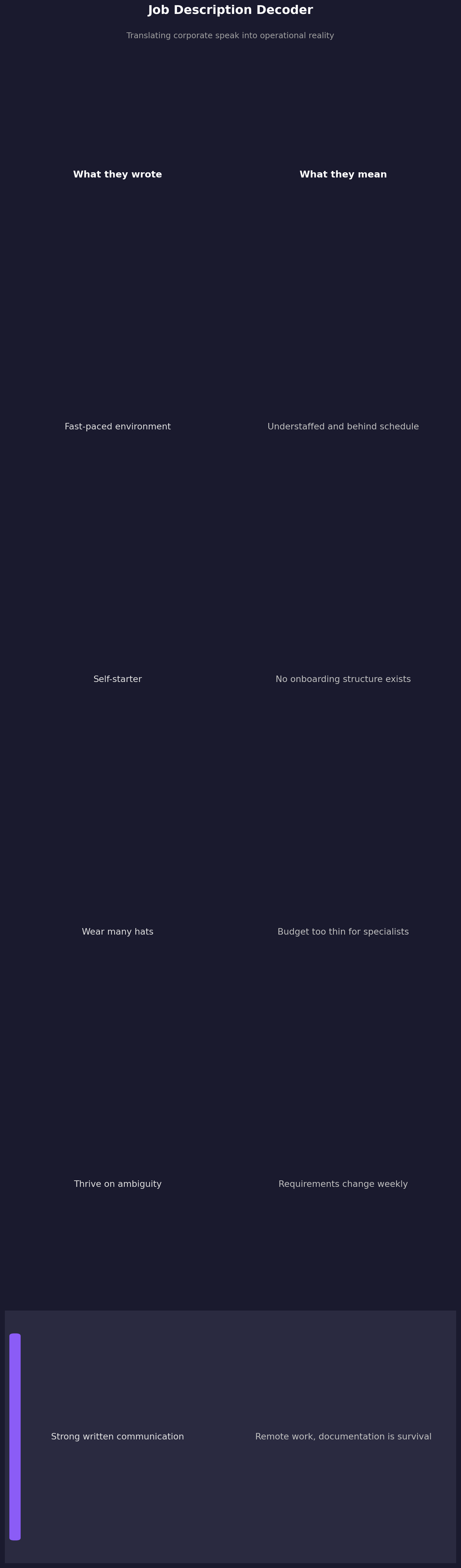
Translation table time:
Build Your Detective File Before the Interview
Paste the JD on one side of a fresh document—Google Docs works fine. On the other, write margin notes: What would make someone write this? That question forces you past the surface verbs and into the operational reality. Then check public signals beyond the ad itself: their engineering blog, changelog announcements, or hiring guides. Pull up their GitHub org and scan commit frequency over the last 90 days—a spike suggests feature velocity; a lull might mean maintenance mode.
If you find references to candidate drop-off rates or specific process bottlenecks, note those too. One candidate landed an offer by spotting that a company’s recent funding round meant rapid scaling pressures. She referenced their stated adoption growth across enterprise clients and tied her experience running migration projects directly to that trajectory. The company had publicly disclosed 340% year-over-year customer growth in a Q3 earnings call, but their engineering blog complained about onboarding latency.
She connected those dots in under two minutes.
That specificity beat any generic enthusiasm speech. It proved she’d done her homework and seen their future role in it. Now replicate her method: find the tension between what they claim and what they ship. Look for their last three product releases on Product Hunt or their public roadmap in Linear, then map your past projects onto those exact milestones.
Aim for at least seven concrete references per page of JD text. One founder I coached kept a table with columns for “Their words,” “My evidence,” and “The bridge sentence.” He filled it over two evenings and walked into the interview with answers already drafted for every likely variant of the question. You don’t need insider access to build this file.
Public record is enough: press releases from Crunchbase, engineer tweets about stack choices, support forum threads complaining about specific bugs. Each item is ammunition you load before you ever shake hands across the table. The file grows stale fast though—check it within 48 hours of your interview date, not three weeks prior.
From Pain Points to Your Proof
That kind of homework only works if you convert findings into evidence. The candidate who mentions their “cloud migration deadline” without showing they’ve done one reads as a parrot, not a partner. Build a simple three-column table before your interview. Left column: the exact pain verb from their posting—”stabilize,” “reduce,” “scale.” Middle column: one piece of public evidence that pain exists, like a changelog entry or engineering blog post. Right column: your concrete proof, quantified wherever possible.
A support engineer eyeing a role at an API company might write: “Scale. Their status page shows three incidents last quarter. I cut our p99 latency from 480ms to 210ms by profiling Redis queries.” That sentence alone answers the question better than any rehearsed passion statement. Now force yourself to connect each row out loud. Say the pain, cite the evidence, state your result. Twenty seconds per row, no more.
Warning: Generic skills lists sink answers fast. “I’m great at communication” appears in every candidate’s script; “I documented our incident runbooks so new hires stopped asking Slack questions within two weeks” appears in almost none. The gap between those two statements is precisely what separates an offer from another rejection email. Maya’s fifth-round answer worked because she named their candidate drop-off metric and tied it to her experience building screening rubrics—not because she liked their mission statement.
Practice compresses that bridge into natural speech. Record yourself answering once unprompted; most people ramble for 90 seconds before reaching their point. A tighter version leads with the pain verb in sentence one, states the proof in sentence two, and lands the connection by sentence four. Thirty seconds total beats three polished minutes of filler every time.
That thirty-second tight version only works if your proof actually targets their problem. Generic achievements are noise. Specific ones are signals. Here’s the exercise: pull up the job description and circle every verb that hints at pain. “Reduce churn.” “Improve onboarding.” “Simplify reporting.” Each one is a gap in their operation, a place where money leaks or time evaporates. Now map your past work to those exact verbs.
If they mention reducing support tickets, don’t say “I have customer service experience.” Say “I cut ticket volume by 32% in six months by rebuilding the self-service FAQ with search logs. I also wrote a Python script that flagged the top fifty unresolved queries weekly.”
The connection must be structural, not thematic. Thematic sounds like this: “We both care about customers.” Structural sounds like this: “You’re losing candidates between application and phone screen; I built a scheduling automation at my last company. That recovered 40% of no-show slots using Calendly’s API.” It works like building a bridge plank by plank. The job description hands you the gap coordinates; your resume holds the raw materials. Each answer should bridge exactly one gap.
Pair one of their stated problems, like “reduce churn,” with a quantified win, such as “cut it 18% in Q3.” Write three such sentences aloud before the interview, timing each under 30 seconds. If a pairing feels forced, rework it until it snaps into place.
When it feels obvious to you, it will feel deliberate to them. That deliberation reads as preparation, not pandering. Preparation is what separates an offer from a polite rejection email arriving 14 days later.
Rehearse Until the Answer Bites Back
Preparation without delivery is just a document you memorized. Maya, the engineer from earlier, rehearsed her pitch into a voice memo app. She listened back on her commute. She caught herself rushing the phrase “reduce screening burden” every single take. Structure is what frees your authenticity, not what cages it. Think of improv comics: they drill scene frameworks for years before a single spontaneous joke lands. Your answer works the same way.
Internalize the skeleton, and the personality fills in live.
Run three timed drills, each under 90 seconds. Set a timer on your phone and record yourself answering “why us.” Then transcribe it with Whisper or any speech-to-text tool. Read that transcript cold. You become embarrassingly visible in print. The second drill forces adaptation: have a friend interrupt mid-answer with a skeptical follow-up like “But you’d say that to any company.” Pause and acknowledge the challenge verbally (“fair pushback”).
Then pivot to your third researched piece of evidence about their specific workflow bottleneck. That pivot takes about eight seconds to execute well; most candidates freeze at four. Drill three is the silence test: deliver your answer, then sit in quiet for ten full seconds before continuing. Hiring managers read that stillness as confidence. Candidates who rush past it read as rehearsed robots reciting flashcards.
One caution: don’t polish until sterile. A senior recruiter I worked with once told me she flags candidates whose answers sound too perfect. Flawless delivery reads as scripted no matter how genuine the content underneath. Leave one natural stumble in there; your brain’s real-time retrieval will handle that for you anyway.
Your final metric isn’t how smoothly you recite—it’s whether you can adapt when they ask “why this team specifically?” That question arrives in roughly 80% of final rounds based on pattern observation across interview panels last year.
A mock interview that can’t generate five distinct follow-up variations isn’t finished. Schedule a second session within 48 hours using the STAR method template from our guide, and drill until your responses feel reflexive. When the interviewer’s four-word question lands cold across the table, you won’t be recalling scripts. You’ll be retrieving internalized research, so your answer flows like recounting an old story to a new friend. That distinction separates sounding hired from sounding like you already belong.
Tip: Record one practice session on your phone and count your pauses; anything above three per two-minute answer needs another round.
Maya’s fifth interview wasn’t luck. She had built her three-part bridge—company evidence, role specifics, quantified impact—but the real transformation happened in the 72 hours Maya ran three timed mock rounds with a friend playing hostile panelist. Each loop forced her to answer under 90 seconds of scrutiny, then re-answer cold after deliberate interruptions. By round two, her delivery had shed its rehearsed sheen.
The difference between prepared and fluent is measurable. Candidates who practice aloud score meaningfully higher on delivery metrics than those who only write out answers; recruiters consistently rank vocal pacing and recovery from interruptions as top signals of genuine fit. Here’s the drill that works: set a timer for 60 seconds. Answer once without notes. Restart if you stumble or drift into generic territory. Then repeat until your opening line arrives automatically, not by recall.
That automatic arrival is what changed Maya’s final round. She named their exact pain point—recruiter screening burden from candidate drop-offs—before they asked about it. The hiring manager leaned forward and said, “That’s precisely our problem.” Generic passion fades against specificity every time. When you can state their unmet need and your proof in one breathless sentence, you’ve stopped auditioning and started consulting.
The insight is simple: your answer only wins when it solves a problem they have already quantified. Maya’s turnaround was not about confidence or charisma; it was about evidence that matched their tracked metrics. She stopped selling herself and started diagnosing their screening bottleneck, which she found buried in an ATS report from March 2026. So before your next final round, ask one question: what metric are they failing to hit, and how does your specific skill move that number?
Keep Reading
- How to Prep for an Interview While Working Full-Time (Without Losin…
- Interview Feedback Scorecards: How Recruiters Weigh Your Signals
- Google Behavioral Interview: Prepare & Stand Out Without Scripts
That single shift separates a forgettable candidate from the obvious hire. The job description holds the clues, but only if you read it for pain points rather than requirements. Take an hour this week to reverse-engineer theirs. It will change more than your answer; it will change which offers you land.